
Established vs New Build: Which Property Actually Builds More Wealth Over 20 Years?
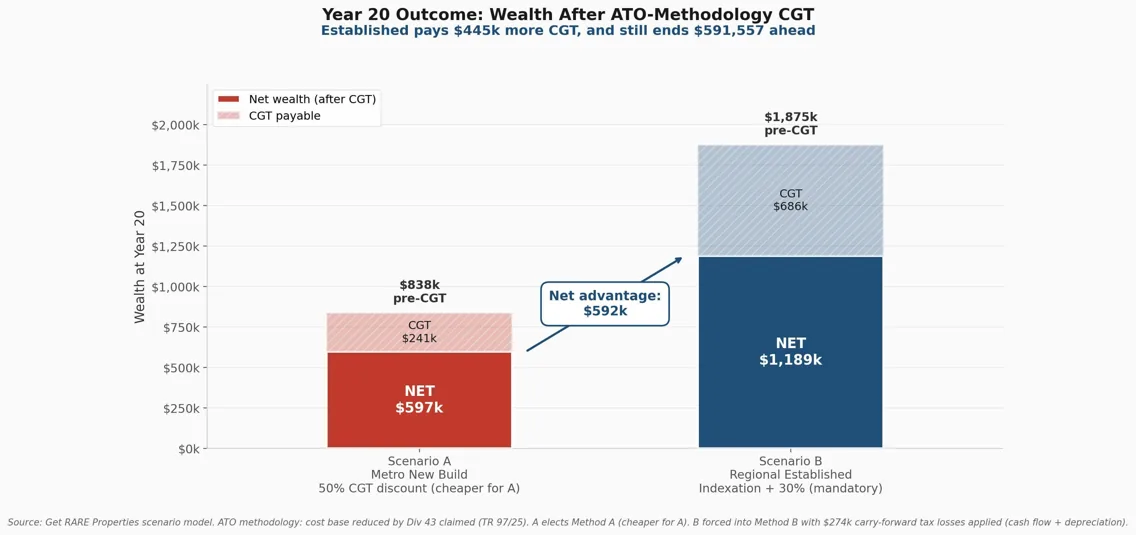
Short answer: established, and the margin is wider than the tax break. In a 20-year model using the same investor, the same $700,000 purchase and the same $175,000 deposit, the established property finishes $591,557 ahead of the metro new build after capital gains tax.
The new build keeps negative gearing. It keeps full depreciation. It gets to elect the cheaper of two CGT methods. It still loses.
Get RARE Properties is Featured On
Key takeaways
- The gap is $591,557 after CGT, on the same $700,000 purchase and the same $175,000 deposit.
- The established property pays $445,458 more in capital gains tax and still finishes well ahead. The bigger tax bill is the cost of the bigger gain.
- Tax-favoured and wealth-favoured are no longer the same property. From 1 July 2027 they point in opposite directions.
- The tax break is real and it is not enough. Negative gearing is worth about $231,000 to the new build over 20 years. The growth it gives up is worth about $1.17 million.
- The result survives stress testing. Even at CoreLogic's actual decade growth rates, which narrow the gap considerably, established still wins by about $430,000 after tax.
What this article covers
- What "established property" and "new build" actually mean
- What the 20-year model shows
- The trade, line by line
- Why tax-favoured is no longer wealth-favoured
- The capital gains tax detail that decides it
- The mechanism: land appreciates, buildings depreciate
- The established property costs more to hold
- Does it survive a harsher growth assumption?
- The four mistakes behind the trade
- New build vs established property: the honest trade-offs
- Four rules to run any pitch through
- Frequently asked questions
What "established property" and "new build" actually mean
An established property is a home that has already been lived in. It has a sale history, a rental history, a street that has already formed around it, and a land value the market has already tested.
A new build is a property sold for the first time: a house and land package, a new release estate, a newly completed apartment, or an off the plan purchase. Nobody has lived in it. There is no price history to check.
Most property buyers understand that difference in general terms. Fewer have priced what it does to a portfolio over 20 years. That is what this article does.
Whichever way you lean, the tax treatment of both paths shifts from 1 July 2027: read our guide to the 2026 property tax changes before you commit.
Established vs new: what the 20-year model shows
We built a 20-year scenario model for this exact question after the 2026 Budget changes were announced. The credibility of a number this size sits entirely on its assumptions, so here they are in full.
The model compares two real choices an Australian investor can make with $700,000 in May 2026. Scenario A is a metro new build, which keeps negative gearing and can elect the better of two CGT regimes. Scenario B is a regional established house, which loses the ability to offset losses against wages and is forced into indexation plus a 30 per cent minimum rate from 1 July 2027.
The assumptions behind the number
| Assumption | A: Metro new build | B: Regional established | Source |
|---|---|---|---|
| Purchase price | $700,000 | $700,000 | Equalised |
| Acquisition costs | 5% | 5% | State revenue offices, LMI |
| Loan / LVR | $560,000 / 80% | $560,000 / 80% | Big four standard |
| Out of pocket | $175,000 | $175,000 | Calculated |
| Investor interest only rate | 6.5% | 6.5% | RBA F5 |
| Gross yield, year one | 4.0% | 4.0% | Equalised, which favours A |
| Rental growth p.a. | 2.5% | 3.5% | Property Investment Professionals, CoreLogic |
| Holding costs | 30% of rent | 25% of rent | PICA, REIA |
| Capital growth p.a. | 4.0% | 7.0% | Property Investment Professionals midpoints |
| Construction value | $450,000 | $280,000 | Cordell 2026 |
| Div 43 capital works | $11,250 p.a. | $7,000 p.a. | ATO Div 43, 2.5% |
| Div 40 plant and equipment, year one | $8,000 | $0 (post-2017) | ATO Div 40 |
| Marginal tax rate | 47% | 47% | ATO top bracket plus Medicare |
| Negative gearing | Retained | Quarantined | Budget Paper No. 1 |
| CGT regime | Better of Method A or B | Indexation + 30% minimum | Budget Paper No. 1 |
| Hold period | 20 years | 20 years | Long-term horizon |
| Inflation, for CGT indexation | 2.5% | 2.5% | RBA midpoint |
Two of those lines deserve a note, because both of them are set against the argument this article makes.
Yields are equalised at 4 per cent. In the real market, metro new build typically yields 2.5 to 3.5 per cent and regional established yields 4.5 to 6 per cent. Equalising them hands the new build a rental income it would not usually earn. And the new build is allowed to elect whichever CGT method is cheaper for it, while the established property is forced into the one the Budget mandates.
The model gives the new build every benefit the Budget offers, and then some. It still loses.
Disagree with any of these assumptions? Good. You can change every one of them in the full model and see what it does to the answer.
Year 20, after tax
| Year 20 metric | A: Metro new build | B: Regional established |
|---|---|---|
| Property value | $1,533,786 | $2,708,779 |
| Cumulative after-tax cash flow | $3,851 | ($134,127) |
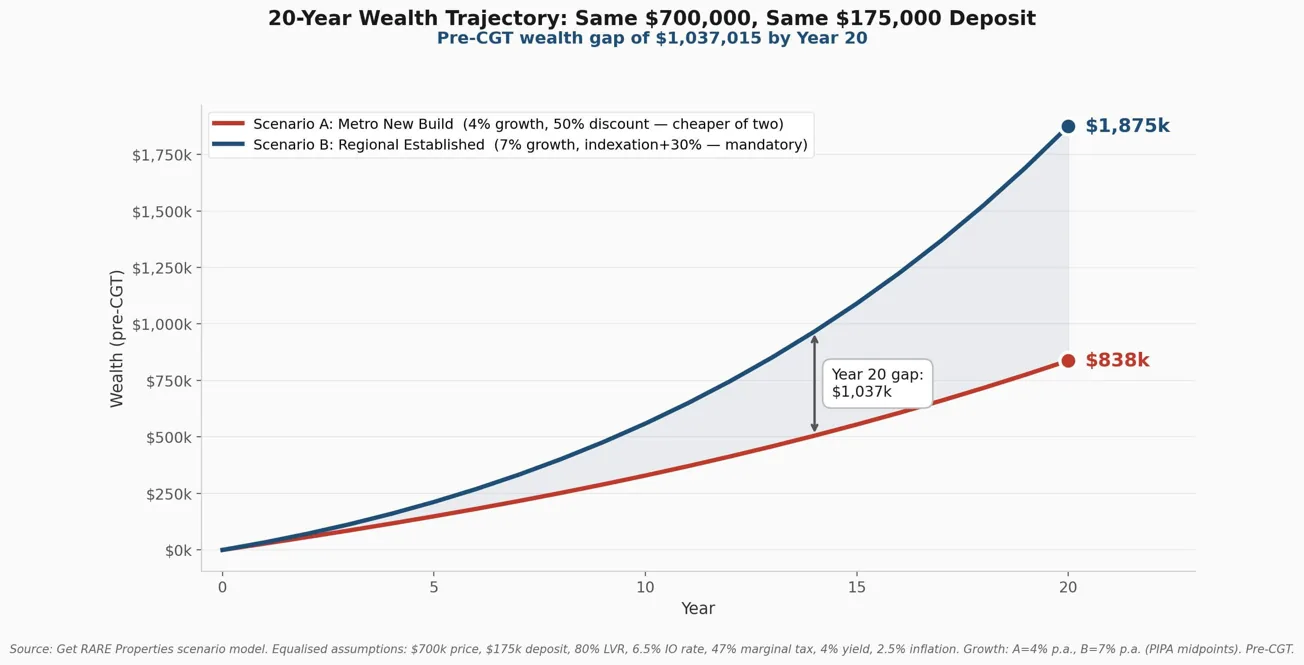
| Pre-CGT wealth | $837,637 | $1,874,652 |
| CGT payable | $240,590 | $686,048 |
| Net wealth after CGT | $597,048 | $1,188,605 |
On the same $175,000 deposit, the established property returns 6.8 times the money in. The new build returns 3.4 times, even after electing the cheaper of the two capital gains tax methods available to it.
The difference is $591,557.
The trade, line by line
It is worth taking this in order, because the trade is not close once you see all four lines rather than the one the brochure shows you.
The tax break everyone is chasing is real. Over 20 years, negative gearing and depreciation are worth about $231,000 to the new build. That is genuine money and I am not going to pretend otherwise.
Then comes the part that rarely gets mentioned. Over those same 20 years, the established property grows about $1.17 million more in value. It costs more to hold along the way, which claws back part of the tax break. And at sale it attracts a much larger capital gains tax bill, because the profit is much larger.
Put every line in one place and it reconciles like this.
| Component | Effect on the gap | Running total |
|---|---|---|
| Capital growth over 20 years | +$1,174,993 to established | +$1,174,993 |
| Cumulative after-tax holding costs | ($137,978) to established | +$1,037,015 |
| Pre-CGT advantage | +$1,037,015 | |
| Additional capital gains tax | ($445,458) to established | +$591,557 |
| Post-CGT advantage | +$591,557 |
A $231,000 tax break chased. A $1.17 million growth gap walked past to get it.
One detail inside that holding cost line is worth pulling out, because it is the most misread part of the whole comparison. The new build's negative gearing shield is worth about $231,000. But the established property claws back roughly $93,000 of it through faster rental growth, at 3.5 per cent against 2.5 per cent, and lower holding costs, at 25 per cent of rent against 30 per cent. The net cash flow advantage to the new build is not $231,000. It is about $138,000.
Why the tax-favoured property is no longer the wealth-favoured property
There are two questions hidden inside every property decision, and most people only ask one.
- Which property gets the best tax treatment?
- Which property builds the most wealth?
For about 30 years in Australia, those two questions had nearly the same answer. Negative gearing applied to new and established properties alike. The 50 per cent CGT discount applied to both. Tax-favoured and wealth-favoured pointed at the same property, so nobody had to think about the difference.
The 2026 Budget separated them.
What changes from 1 July 2027
From 1 July 2027, on new acquisitions of established stock, losses can no longer be offset against wage income. They are quarantined and carried forward. Capital gains tax moves to an indexation method with a 30 per cent minimum rate. New builds keep negative gearing and full depreciation, including plant and equipment.
So the tax-favoured column now points firmly at fringe new build. The wealth-favoured column still points exactly where it always pointed: land-rich established stock in a proven location.
Most of the coverage since the Budget answers the first question and quietly assumes the answer to the second is the same. It is not.
The geography problem nobody is pricing in
New developments need land cheap enough to build on. Cheap land sits on the urban fringe. So the property class the Budget just made tax-favoured is, almost by definition, the property class furthest from the jobs, the infrastructure and the demand.
Established suburbs are the inverse. Closer to the CBD, closer to the schools, closer to the things that make a better location a better location. That is why established stock grew faster historically, and why it keeps growing faster.
In practice, this means the tax break is being offered to you in the geography with the weakest structural demand.
The capital gains tax detail that decides it
This is the part of the model that surprises people most, so it is worth setting out in full rather than summarising.
Under ATO Taxation Ruling TR 97/25, the Div 43 capital works deductions you claim while you own a property reduce your cost base when you sell it. That applies to both scenarios, and it hits the new build harder, because the new build claims more.
| CGT element | A: Metro new build | B: Regional established |
|---|---|---|
| Sale value at year 20 | $1,533,786 | $2,708,779 |
| Initial cost base, price plus 5% | $735,000 | $735,000 |
| Less cumulative Div 43 claimed | ($225,000) | ($140,000) |
| Adjusted cost base per TR 97/25 | $510,000 | $595,000 |
| Nominal gain | $1,023,786 | $2,113,779 |
| Less carry-forward tax losses | $0 | ($274,127) |
| Adjusted gain | $1,023,786 | $1,839,652 |
| Method A: 50% discount at 47% | $240,590, elected | Not available |
| Method B: indexation, minimum 30% | $328,103, rejected | $686,048, mandatory |
| Final CGT payable | $240,590 | $686,048 |
Read the last three rows slowly, because they contain the whole argument in miniature.
The new build gets to choose. Having that choice saves it $87,513, because Method A comes in cheaper than Method B on its numbers.
The established property does not get to choose. On the same gain, Method A would have produced a bill of $432,318. It is forced into Method B at $686,048. Being denied the choice costs it $253,730.
So the Budget hands the new build a better tax regime, and then hands it the right to pick the better of two. The established property absorbs a quarter of a million dollars of additional tax purely from losing that election.
And it still finishes $591,557 ahead.
That is the point worth sitting with. Every tax variable in this model is set in the new build's favour. The growth differential dominates all of it.
The mechanism: land appreciates, buildings depreciate
The 7 per cent versus 4 per cent growth difference is not a forecast, and it is not a guess. It is a structural property of what you have actually bought.
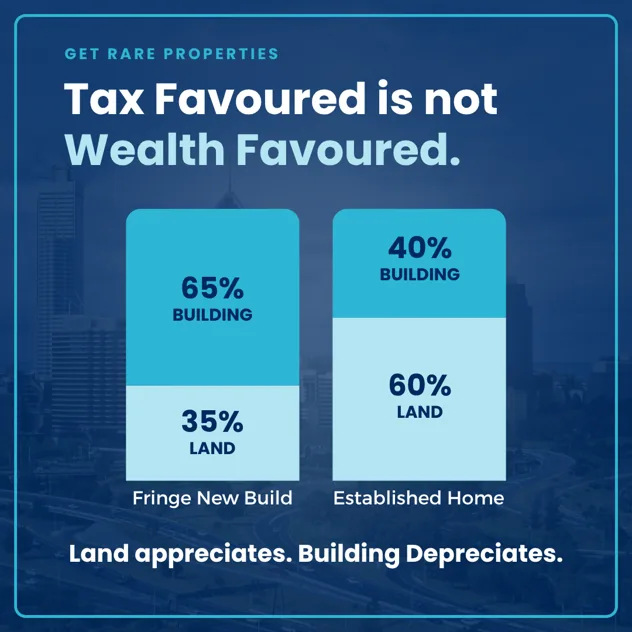
Look at the construction values in the assumptions table. On the same $700,000 purchase price, the new build carries $450,000 of building. The established house carries $280,000. Those come from the Cordell 2026 cost guide, and they are the whole story in two numbers.
The new build is roughly two thirds building and one third land. The established house is closer to the reverse.
Land appreciates. Buildings wear out. That is not a slogan. It is how the two halves of a property behave over decades. The land under an established home is doing the compounding. The building on top of it is depreciating slowly, every year you own it, which is precisely why you can claim a deduction for it.
On a fringe new build you have inverted the ratio. More of what wears out, less of what compounds. The growth gap is not a prediction about the future. It is a starting condition, baked in on settlement day.
This is also the honest answer to a question I get often: what decreases property value the most? Rarely one dramatic event. Most often it is a high building-to-land ratio, in a location where demand has not been proven, sitting next to more supply of exactly the same thing.
If you want the full reform package in one place, including the source list and the scenarios behind these charts, it all sits on the 2026 Budget property reform briefing page. The full 20-year model is available there, so you can run your own numbers rather than mine.
The established property costs more to hold
I want to be straight about this, because it is the strongest argument on the other side and skipping it would be dishonest.
Over 20 years, cumulative after-tax cash flow on the new build is a shade positive at $3,851. On the established property it is negative $134,127.
So yes. In this model, the established property is the one that draws on your income. Roughly $6,700 a year, on average, out of your take-home pay. That is not nothing. It is a real constraint on real households, and any adviser who waves it away is not doing their job.
Two things explain it. Yields are equalised at 4 per cent, which flatters the new build considerably. And the established property loses the ability to offset its losses against wages, so it wears the shortfall without the annual tax relief.
Here is what you get for that $134,127. An extra $1,174,993 of capital growth, and $274,127 of quarantined losses that come back at sale as a credit against the capital gain. The holding cost is not lost money. Part of it is deferred, and all of it is buying growth.
Which brings me to the framework underneath all of this. Every property in a portfolio has a job. A Growth Engine grows the equity base. A Yield Stabiliser funds the holding costs. A Value-Add accelerates equity through renovation or structural improvement.
Tax shelter is not a job. It is a side effect. A property that cannot earn its place doing one of the three real jobs will not be rescued by its tax treatment over 20 years. And a portfolio built properly uses a Yield Stabiliser to fund the holding costs of a Growth Engine, which is exactly the problem this single-property comparison cannot show you.
Does it survive a harsher growth assumption?
The fair challenge to any model like this is that the answer was decided by the growth inputs. So we stress tested it.
The base case uses Property Investment Professionals' long-run midpoints: 7 per cent for established, 4 per cent for new build. The conservative case throws that out and uses CoreLogic's actual recorded growth over the decade to 2025, which is 5.8 per cent and 3.4 per cent, a materially narrower gap.
| Growth scenario | Growth, A / B | Pre-CGT advantage | Post-CGT advantage |
|---|---|---|---|
| Conservative, CoreLogic decade actual | 3.4% / 5.8% | $657,619 | $429,864 |
| Base case, Property Investment Professionals midpoints | 4.0% / 7.0% | $1,037,015 | $591,557 |
| Optimistic, Property Investment Professionals top of range | 5.0% / 8.0% | $1,267,384 | $637,625 |
Established wins in all three, after tax, while paying substantially more tax in each one. The number moves. The answer does not.
The model is also deliberately conservative in ways that work against the case it makes. The loan is held flat with no re-leveraging. There is no portfolio compounding, so the established property's faster equity growth never gets recycled into a second purchase. In practice that is exactly what it would be used for, and it would widen the gap rather than narrow it.
The four mistakes behind the trade
When I look at why capable people get this wrong, it comes down to four things.
One. Mistaking tax efficiency for wealth efficiency. Negative gearing is a cash flow benefit, not a wealth engine. New builds optimise the first. Established optimises the second. They are not the same objective and the Budget has now forced you to choose between them.
Two. Underweighting the land. Land appreciates and buildings wear out. New builds on the fringe carry a small slice of land under a large depreciating building. Established homes in tightly held suburbs are the reverse.
Three. Ignoring resale. This one is genuinely new and almost nobody is discussing it. A new build bought after 12 May 2026 cannot be negatively geared by the person who buys it from you. Your future buyer pool shrinks, because the tax feature you paid for does not travel with the property. For an investor holding several, that risk compounds across the portfolio.
Four. Optimising for the visible. The tax break shows up every year on your return. The growth gap only shows up once, at sale, twenty years later. Human beings chase the visible and discount the invisible, and the entire new build sales model is built on exactly that tendency.
New build vs established property: the honest trade-offs
None of this means new builds have no advantages. They do, and it is worth being clear about them, because pretending otherwise is just the same salesmanship pointed the other way.
| New build | Established property | |
|---|---|---|
| Depreciation benefits | Full capital works plus plant and equipment depreciation | Capital works only on qualifying homes, usually far smaller |
| Negative gearing after 1 July 2027 | Retained against wage income | Quarantined, carried forward to sale |
| CGT method | Can elect the cheaper of two | Forced into indexation plus 30% minimum |
| Cash flow during the hold | Better. Around breakeven in this model | Worse. Around $6,700 a year in this model |
| Maintenance costs | Low in the early years. Builder's warranty. Less wear and tear | Higher. Older properties need repair and replacement over time |
| Energy efficiency | Generally better. Newer standards, lower running costs | Varies. Often the weak point of an older home |
| Stamp duty | In some states, assessed on the land component only for house and land packages. Check the rules in your state | Assessed on the full purchase price |
| Grants and incentives | First home owner grant and new-build incentives may apply, but generally to owner occupiers, not investors | Rarely eligible |
| What you are buying | A fixed price contract and a plan. You cannot inspect what does not exist yet | You know what you are getting. You can inspect it, and see what the street and the suburb have already done |
| Vacancy risk | Higher in new estates where many identical properties reach the rental market at once | Lower where the rental market is established and the stock is not uniform |
| Renovation and value-add | Almost none. It is already brand new. There is no lever to pull | Real. A dated but structurally sound home can be improved to add value |
| Resale position | Your buyer cannot negatively gear it. Smaller future buyer pool | Unchanged. The next buyer faces the same rules you did |
| Price transparency | No historic price data for the property, and often none for the street | Comparable sales, rental history, and 10 to 30 years of suburb data |
| Hidden costs | Site costs, upgrades, landscaping, fencing, holding costs during the build | Fewer surprises at purchase, but budget for repair and maintenance |
| Long-run capital growth | 3 to 5 per cent, Property Investment Professionals long-run range | 6 to 8 per cent, Property Investment Professionals long-run range |
Read that table honestly and the pattern is clear. New properties often come with better tax outcomes, better cash flow and lower early maintenance costs. Established homes may require more maintenance, more work and more money along the way.
The advantages of a new build are real, and they are concentrated in the first five to seven years. The advantages of established compound for the entire hold.
That is the trap. A 20-year decision made on a five-year tax window does not just cost money. It costs a decade you cannot get back.
Four rules to run any new build pitch through
If you have a pitch in your inbox right now, you are not being unreasonable for finding it persuasive. It is built to be. The tax story is genuine and the brochure is beautiful. What it lacks is a test.
Here are four. Each one has a number, so the answer is not a feeling. Save this section.
Rule one. Yield above 4 per cent gross in year one. If a pitch needs negative gearing to be defensible, the tax is doing the work, not the asset. Worth noting that our model handed the new build a 4 per cent yield it would not normally achieve, and it still lost. Most fringe new build sits at 2.5 to 3.5 per cent in the real market.
Rule two. Land share above 60 per cent of the purchase price. Ask the developer for the land valuation as a percentage of the contract. Most will not supply it. That refusal is your answer. You are being sold a building first and a piece of land second, when the long-term capital growth comes from the land.
Rule three. Ten years of historic population growth, minimum. Not projected growth. Historic growth. A fringe estate built on a forecast needs the forecast to come true for the maths to work. A middle ring suburb that has grown for 30 years is a suburb where demand is already proven.
Rule four. Bottom of the price tier for the area, with value-add potential. This comes from the 4 Rights Framework: right attributes, right location, right property, right price. A brand new house at the top of a fringe estate's price tier, with nothing to improve because it is already new, fails right price and the value-add test at the same time. You are buying retail with no lever to pull.
Run a real pitch through it
Take the kind of pitch already sitting in an inbox this week. A $700,000 house and land package in a growth corridor. Three per cent gross yield in year one. Land valued at 35 per cent of the contract. Brand new release, so no historic price data. Premium price for the standard floor plan.
- Rule one: 3 per cent yield. Fails.
- Rule two: 35 per cent land. Fails.
- Rule three: new release. Cannot answer.
- Rule four: top of the tier. Fails.
Four rules. Four failures. And that is before the brochure has mentioned a single tax benefit.
Then run it through the 24-Month Win Test, which is three questions we ask before any acquisition. What is the job of this asset? What is the finance impact? What does winning look like in 24 months?
The job is tax shelter, which is not a job. The finance impact is a deposit committed to a 4 per cent growth asset. The 24-month win is a depreciation schedule, which is the tax column doing the work rather than the asset.
When a new build is the right buy
None of this means every new build is wrong.
A new build in a proven middle ring suburb, priced correctly, with strong land content, can absolutely earn its place. Plenty of investors hold both new and established properties for sound reasons. If your borrowing capacity is stretched and you need the cash flow relief to hold the portfolio you already have, the new build's cash flow profile is a legitimate reason to consider it. The right mix depends on individual circumstances, the stage you are at, and what the rest of the portfolio already owns.
What is wrong is using "new build" as shorthand for "fringe house and land package", and then assuming the tax wrapping makes the maths work. It does not. The property still has to earn its place doing one of the three real jobs.
The Budget did not break property investment. It made the structural question more important than the tax question. That favours investors who make investment decisions inside a framework rather than inside a five-year window. It rewards the order of your decisions, not the speed of them.
Frequently asked questions
Is it better to buy an established property or a new build?
For most investors building long-term wealth, established. In our 20-year model, the established property finished $591,557 ahead after CGT on the same $700,000 purchase and the same $175,000 deposit. New builds win on tax treatment, cash flow and early maintenance costs. Established wins on capital growth, and growth compounds for longer.
What does "established property" mean?
An established property is a home that has already been lived in and sold at least once. It has a price history, a rental history, and a proven suburb around it. The opposite is a new build: a house and land package, a new release, or a newly completed apartment sold for the first time.
What are the key differences between a new home and an established home?
A new home has better depreciation benefits, better cash flow, lower early maintenance costs and better energy efficiency, but a low land share and no price history. An established home has a higher land value as a share of price, proven demand and value-add potential, but higher repair and maintenance costs and, after 1 July 2027, no offset against wage income.
Which property type offers better capital growth: new or established?
Established, historically. Property Investment Professionals' long-run analysis puts established growth at 6 to 8 per cent and new builds at 3 to 5 per cent. CoreLogic's actual decade to 2025 records 5.8 per cent and 3.4 per cent. The mechanism is land share. Land appreciates and buildings depreciate.
Doesn't the established property cost more to hold?
Yes. In our model, cumulative after-tax cash flow over 20 years is positive $3,851 on the new build and negative $134,127 on the established property, roughly $6,700 a year. That is a real constraint. What it buys is $1,174,993 more capital growth, plus $274,127 of quarantined losses that return as a credit against the capital gain at sale.
What are the tax implications and depreciation benefits for new vs established properties?
New builds claim full capital works and plant and equipment depreciation and keep negative gearing against wages after 1 July 2027. Established properties claim capital works only and have losses quarantined. Under TR 97/25, capital works claimed reduce your cost base at sale, so part of the depreciation benefit returns as capital gains tax.
Does the result hold if capital growth is lower than assumed?
Yes. We tested three growth scenarios. At CoreLogic's actual decade rates of 3.4 and 5.8 per cent, a materially narrower gap than the base case, established still finishes about $429,864 ahead after tax. At Property Investment Professionals midpoints it is $591,557. At the top of the Property Investment Professionals range it is $637,625.
Why does the established property pay so much more capital gains tax?
Two reasons. The gain is far larger, and from 1 July 2027 established stock is forced into the indexation plus 30 per cent minimum method with no election. On the same gain, the 50 per cent discount method would have produced $432,318. The mandated method produces $686,048, so losing the choice costs $253,730.
How do maintenance costs compare between new and old properties?
New properties typically cost less to maintain for the first five to ten years and come with a builder's warranty. Older properties need ongoing repair and replacement as fixtures reach end of life. Our model reflects this through holding costs of 25 per cent of rent for established against 30 per cent for new build.
Can I sell a new build to another investor later?
You can, but the buyer cannot negatively gear it if it was bought after 12 May 2026. The tax feature you paid a premium for does not transfer. That shrinks your future buyer pool, and for investors holding several new builds the effect compounds across the portfolio.
What factors decrease property value the most?
Rarely one event. Most often it is a high building-to-land ratio in a location with unproven demand and abundant identical supply. The building wears out, the land is a small share of the price, and new stock next door competes with yours.
Are new builds better for first-time property investors?
Not automatically. The depreciation and the fixed price contract feel safe, and the cash flow is easier. But a first investment property sets the borrowing capacity and the equity base for everything that follows. A weaker growth asset bought first can delay the second purchase by years.
Can you renovate a new build property to add value?
Very little. It is already brand new, so there is nothing to improve and no discount to buy. Value-add potential is one of the structural advantages of an established home, and it is the lever most fringe new builds simply do not have.
How this model was built
Model outputs. Every dollar figure in this article comes from the Get RARE Properties 20-year scenario model, built by Rasti Vaibhav and dated 2 June 2026. They are illustrative outputs of the assumptions published above, not forecasts, and not a guarantee of any outcome. Change the assumptions and the numbers change. The full Excel model is available on request, with source citations in the cell comments.
Capital growth. Property Investment Professionals long-run analysis: established 6 to 8 per cent, new builds 3 to 5 per cent. CoreLogic decade to 2025: 5.8 per cent and 3.4 per cent.
Tax and CGT. ATO Taxation Ruling TR 97/25 for capital works and cost base. ATO Rental Properties Guide 2024 to 2025 for Div 43 and Div 40. ATO 2024 to 2025 marginal rate schedule, 45 per cent top bracket plus 2 per cent Medicare levy.
Policy. Treasury 2026 to 2027 Budget Paper No. 1, page 155, and the Government media release of 12 May 2026. Confirm the final legislated detail before acting.
Other inputs. Interest rates: RBA F5 monthly statistics, April 2026, big four investor interest only average. Construction costs: Cordell Construction Cost Guide 2026. Holding costs: PICA benchmarks and REIA quarterly cost of ownership data. Yields: PropBoss 2026, Search Property, CoreLogic rental yield data.
Independence. Get RARE Properties receives no payments from developers, builders or project marketers, and no commissions from sales agents. The model gets to say what the model says.
The full Excel model is available here.
Where to take this next
Three places, depending on where you are.
If you want the whole reform package, the model, the scenarios and the source list, start with the 2026 Budget property reform briefing page. The full 20-year model is published there, so you can put your own income, deposit and marginal rate into the same framework.
If you want to understand how a portfolio gets sequenced over 10 to 15 years, our free property workshops cover the framework in more detail.
And if you are looking at a specific pitch right now, or working out where a purchase like this sits in a portfolio you have already started building, the strategy call is where that question gets a real answer. A structured 60-minute conversation, built around your actual numbers. We use it to work out what stage you are in, what the next decision should be, and whether the answer is to act or to wait. Sometimes the answer is to wait.
One last thing, and it is the reason any of this matters. The point of a portfolio is not the number. It is what the number gives you: confidence, flexibility, and the freedom to make work a choice rather than a necessity. A pitch that asks you to trade a 20-year outcome for a five-year tax window is asking you to trade those things for a deduction.
Scarcity and land drive property wealth in Australia. Depreciation schedules do not. The Budget did not change those forces. It changed the cost of ignoring them.
Tax-favoured is not wealth-favoured. They have never been the same property.
Get RARE Properties has guided Australian families through more than $300 million in strategic property acquisitions, and receives no payments from developers, builders or project marketers, and no commissions from sales agents. This article is general information only and is not personal financial, tax or legal advice. Speak to your accountant about your own situation.

About the author
Rasti Vaibhav is the founder of Get RARE Properties, an independent buyer's agency for property investors. He is a CFA Charterholder and spent more than nine years managing institutional portfolios at Westpac and AMP Capital before founding the firm in 2020. He sits on the REINSW Buyers' Agent Chapter Committee and is the author of The Property Wealth Blueprint.