The budget just killed lazy property investing. Here's what replaces it. Three days after the 2026-27 budget, a single conversation saved one of my clients $40,000. In the next 10 minutes, I'll show you the four-question diagnostic that made that possible, and tells you whether negative gearing reform actually changes anything for you. If you have had three different pieces of advice this week and none of them agreed, you are not confused.
Their advice is contradictory because most of it is reading the headline, not the structure. I am Rasti Vaibhav. CFA Charterholder, 9 years managing institutional money before I built a personal 21 property portfolio across the country. Post-budget, within the first few days, three clients, three different situations, one diagnostic. Over the next 10 minutes, I'll show you what the budget actually changed and what it didn't.
The chart no developer-funded channel will put on screen. A $933,000 difference on the same $700,000 purchase. The four-question diagnostic and how a client I'll call Sandy went from $280,000 stuck to $776,000 in equity in 36 months using exactly this framework. The 2026-27 budget was the largest change to property investment taxation in 27 years. Within the first week of budget night on 12th May, I've taken three phone calls that tell you everything about where most investors are right now.
The first, a buyer who had done everything right. Deposit ready, borrowing capacity confirmed, plan in place, now frozen. Because the advice they had been given in 5 days contradicted itself four times. The second, an owner whose accountant said, "So, the property is done for." Selling it costs $40,000 in transaction costs for nothing. The third, three properties built quickly in the low rate window.
Quietly asking the question every mid portfolio investor in this country is asking right now. Was that strategy or was that luck? Three people, three questions, all wrong. Because they are all reacting to the headline. None of them is looking at the structure.
Here's a claim and I'll back every word before the end of this video. The budget changed the cost of being wrong. It didn't change the engine of being right. By minute six, four questions will tell you which side of that line you're on. If you can answer all four with a real dollar number, the budget barely affects you.
If you can't answer two of them, you've just discovered why the next 10 years of property won't look like the last 10. There's a principle that sits underneath all of this. We call it buffers before bravado. For 20 years, the Australian property market didn't enforce it. Because capital growth at 6 to 8% a year forgave almost every mistake.
The budget just ended that forgiveness. I'll show you buffers before bravado in action when we get to Sandy. Three things are being misreported this week. I'll walk you through each. The second is sharper than the first.
And the third, the one no developer-funded channel will name, is the deepest. First, what the headlines got wrong about negative gearing. Most of the coverage since budget night has read negative gearing is dead. That's not what the budget said. For purchases of established property after 7:30 p.m. on 12th May, negative gearing losses are quarantined and carried forward against future rental income or future capital gains.
The 50% CGT discount gets replaced from 1st July 2027 by indexation and a 30% minimum tax on real gains. New builds remain eligible for both. Existing investors are fully grandfathered. That's all announced, not yet law, but assume it passes. The tax benefit isn't gone.
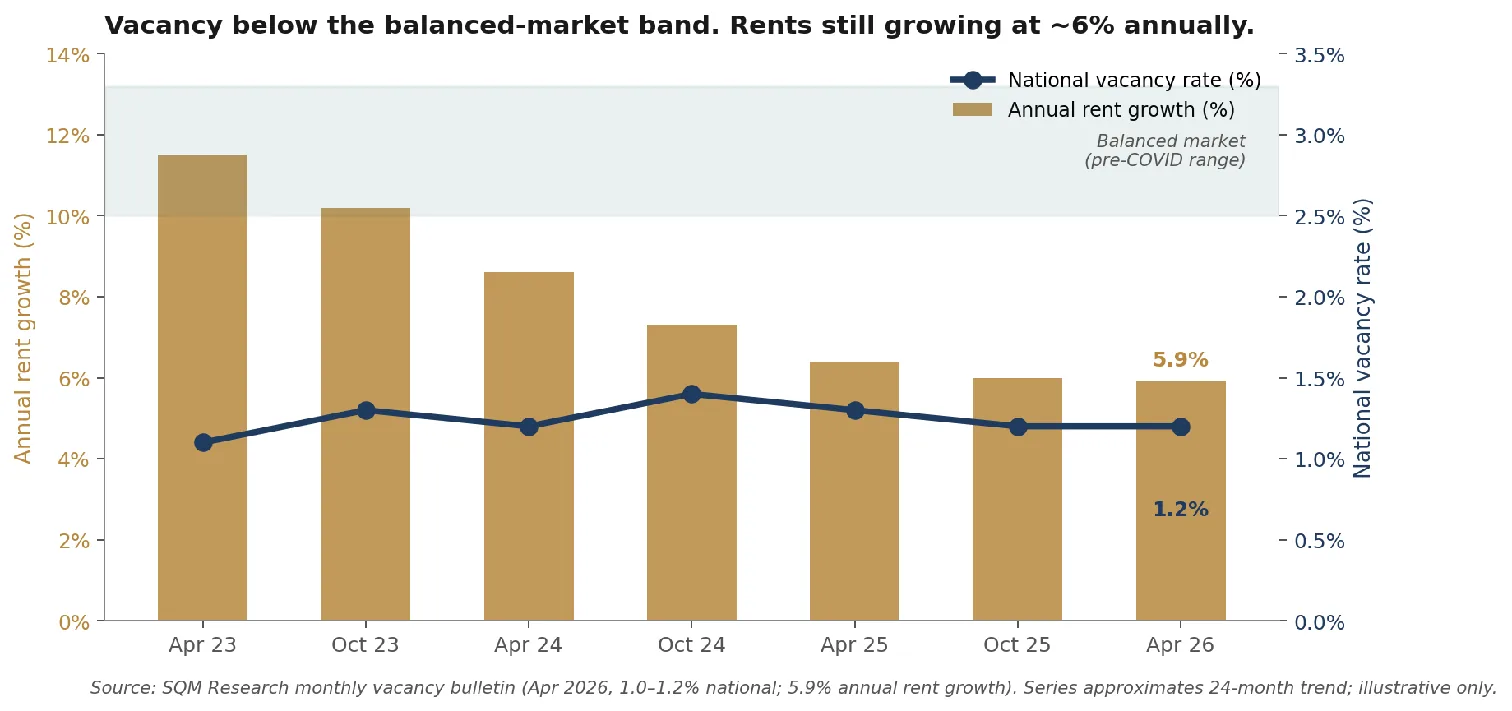
It has shifted in time. National rents are growing at 5.9% a year. Most properties bought today turn positive within 3 to 5 years anyway. The policy didn't kill the tax benefit. It pushed it forward by 3 to 4 years.
That's a delay, not a death. Now, to the second thing being misconstrued. This is the moment where Australia's biggest bank openly disagreed with the Treasury. The Treasury modelling note estimated the negative gearing change adds around $2 a week to median rents. CBA's senior economist, modelling the exact same change, called it the equivalent of a 90 to 155 basis point rate rise on investor mortgages.
National vacancy is sitting at 1.0 to 1.2%. Pre-COVID, a balanced market sat between 2.5 and 3.5%. We're materially below balanced. Net overseas migration to June last year was 306,000 people. The supply gap between population growth and dwelling completions was 250,000.
You don't get a rent freeze with a quarter of a million more people than houses. Rents grow. Now, to the third thing. This is the one nobody else is naming out loud because most of the people commenting on the budget are paid by the part of the industry that benefits from this confusion. New builds are being repositioned this week as a smart play under the new rules.
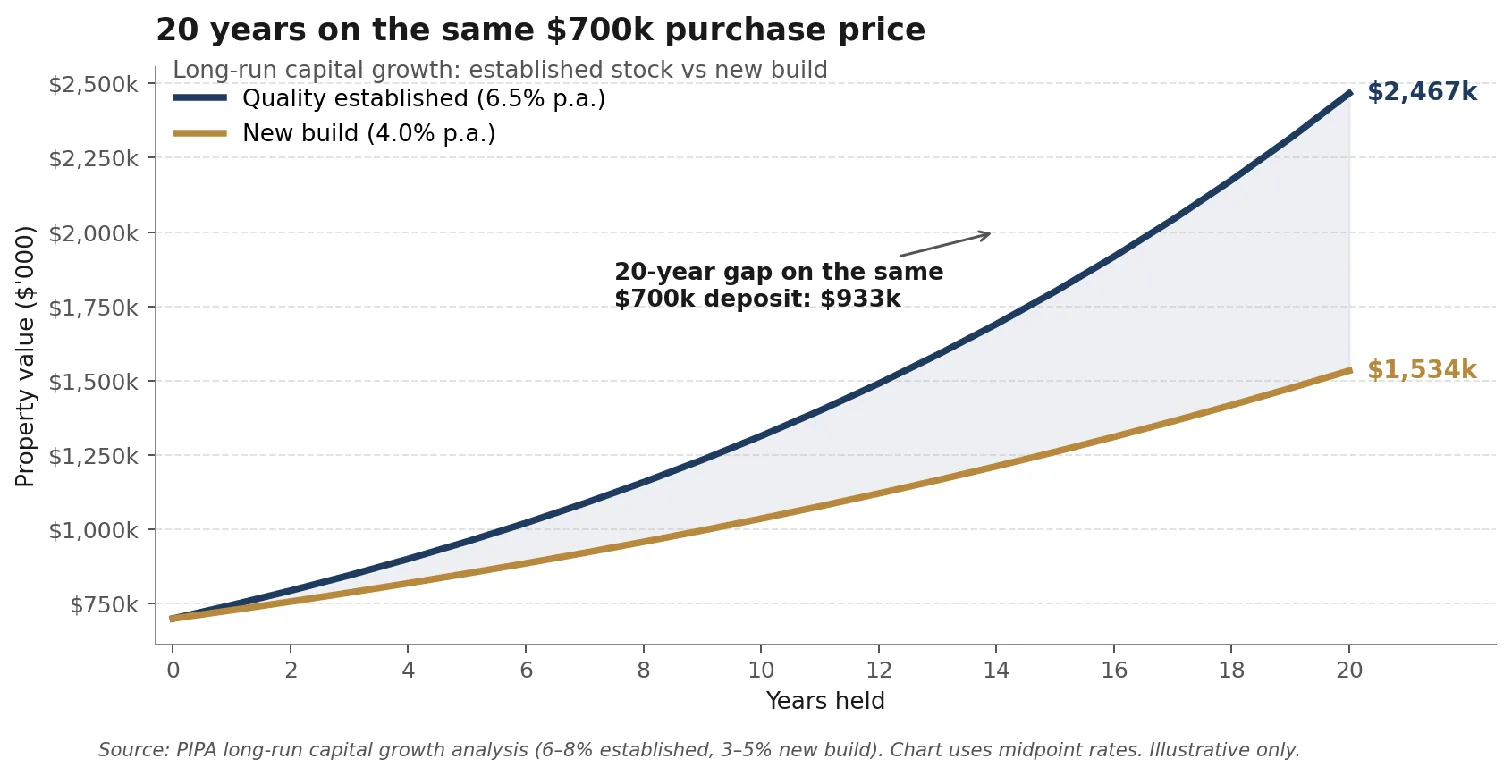
The tax advantage on new build is real. The wealth disadvantage is bigger. The Property Investment Professionals of Australia, PIPA, published long-run data on this. Established stock compounding at 6 to 8% a year. New builds at 3 to 5.
On the same $700,000 purchase over 20 years, that gap is about $933,000 in your pocket. Saving 30 grand in tax to lose nearly a million dollars in growth isn't a strategy. It's a sales pitch. Most channels can't put that chart on screen because their revenue depends on developer commissions. That's not an accusation.
It's a reason to ask the question, because the budget exposed something nobody else is naming out loud. Tax was the cost of being wealthy. It was never the cause of it. Neither negative gearing, the 50% CGT discount nor trust distributions for 20 years built wealth on their own. They reduce the cost of holding the assets that build wealth through capital growth and rent.
The budget changed the cost. It didn't change the engine. And almost the entire investor strategic question right now hinges on knowing the difference. This is where it gets practical. Get ready to remember this if you are driving.
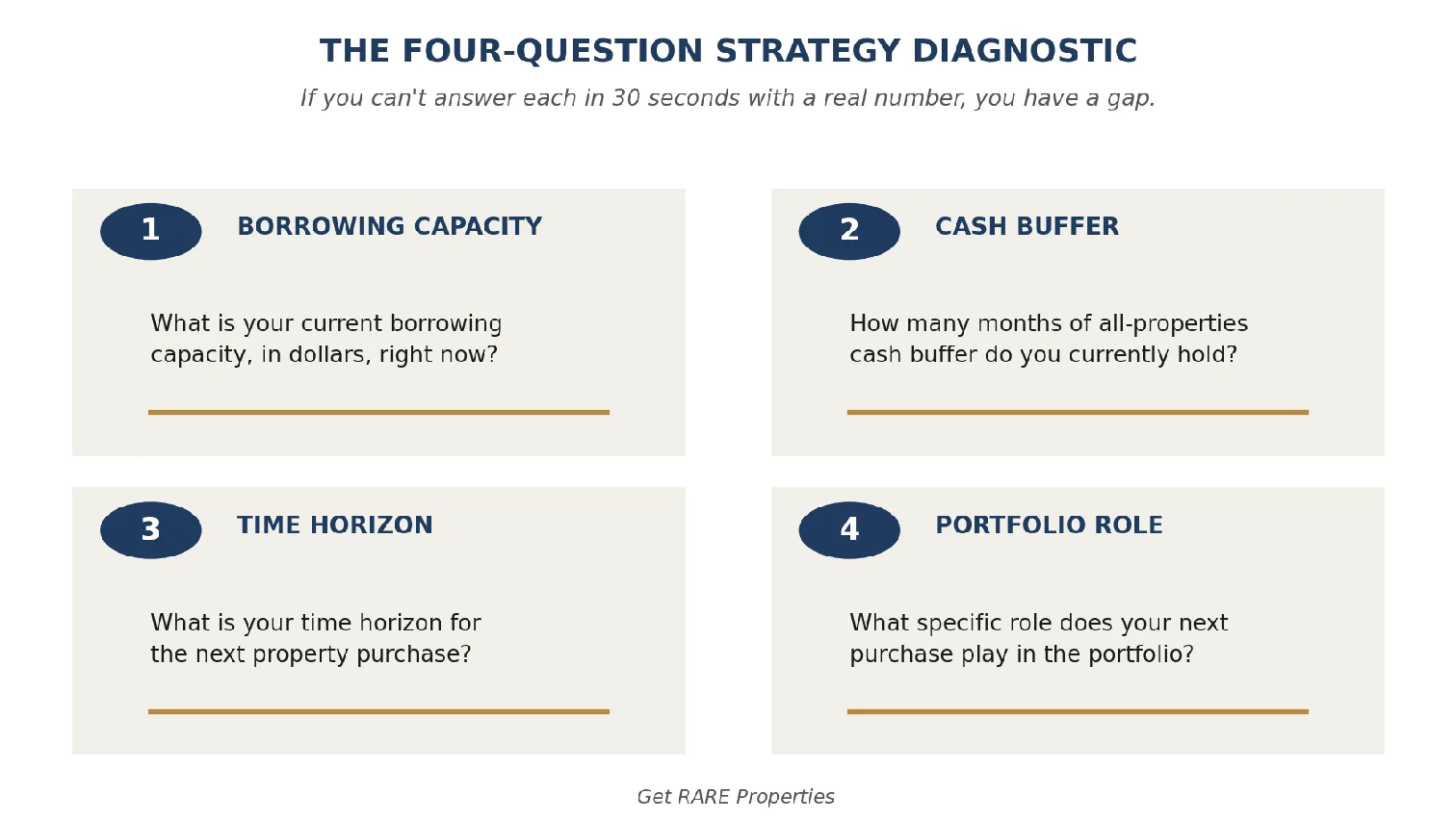
Four questions, each one takes 30 seconds. They sound simple. They are not. Each one is a question I have spent 15 years working with institutional and retail capital learning to ask properly. They sit at the centre of what we call the property wealth blueprint.
I've compressed them into a 2-minute test for you. Try them now as I go. Question one. What's your current borrowing capacity in dollars right now? Not what it was 2 years ago, not what your broker said 6 months ago, but today.
The cash rate is at 4.35%. APRA's serviceability buffer has been three percentage points since October 2021. The new debt-to-income cap of six times income kicked in on 1st February 2026. Borrowing capacity is structurally tighter than it has been in 15 years. If you can't name your number, you can't sequence your next move.
Full stop. Question two. How many months of whole-portfolio cash buffer do you currently hold? Cash in offset across the whole portfolio. Enough to weather three to six months of vacancy, a 1 to 2% rate rise, and one unexpected repair.
This is the buffers before bravado question I mentioned earlier. For 20 years, capital growth bailed out everyone who borrowed at maximum capacity with no margin. The budget just removed that bailout. Your buffer is no longer optional. It's an entry ticket.
Question three. What's your plan horizon for the next purchase? Not soon, not this year. How many years before this asset needs to do its job? The new CGT rules start on 1st of July 2027.
The day before, 30th of June 2027, is the split. Anything you buy now and hold for 10 to 15 years sits across both regimes. Question four. What specific role does your next purchase play in the portfolio? We call this the asset job framework.
Three roles. Growth engine, income stabiliser, value add. Every asset does one of them. If you can't tell me which one your next property is, you're not buying for the portfolio, you're buying the property. Four questions, two minutes.
If any of them gave you pause, that's not a sign you've done something wrong. It's a sign the market stopped charging you for the gap. Now, it will. What happens when someone actually has all four questions answered beforehand? Four years ago, I sat down with a client.
I'll call him Sandy. IT professional, mid-40s, two kids, working too many hours. He came in with $280,000 in equity and $210,000 in cash. And he was stuck. Not because he didn't have the resources, he clearly did.
He was stuck because every piece of advice he had received over 18 months had pulled him in different directions. Sydney, wait, shares, Brisbane, his own home. He didn't have a market problem. He had a clarity problem. So, we ran the four questions.
Borrowing capacity confirmed across three lenders. Buffer 12 months, logged across every future property. That's buffers before bravado in action. Non-negotiable before any acquisition. Time horizon 15 years.
Asset role mapped per purchase using the asset job framework. Growth engine, yield stabiliser, hybrid. Four properties over 36 months. All four regional. Four different states.
Now sitting with $776,000 in equity growth. This outcome wasn't because property went up. Property went up for everyone in that window. His outcome was buying the right properties in the right order with the right buffers. The diagnostic is what made it possible.
One more example. This one from this week. Three days after the budget, another client called me. He wanted to sell an established property because his accountant said negative gearing was, quote, dead, unquote. We ran the same four questions.
Borrowing capacity intact. Buffers 12 months. Time horizon 20 years. Will clear the 2027 transition. Portfolio role, yield stabiliser.
Doing exactly its job. Here's the part the accountant missed. The property was grandfathered. The budget didn't touch it. The right answer was to do nothing.
That conversation prevented the $40,000 mistake I mentioned at the start of this video. That's what the four questions are for. Not to make you act faster, to make sure you don't act on the wrong thing. So, let me close where I started. For 20 years, capital growth at 6 to 8% a year bailed out almost every property mistake in this country.
Wrong property, wrong order, no buffer, no plan. The market forgave all of it. The 2026-27 budget removed the forgiveness. Buffers before bravado isn't a slogan anymore. It's an entry ticket.
The budget didn't break property. It stopped subsidising the lazy version of it. If you couldn't answer the four questions on the first pass, you don't have a property problem. You have a clarity gap. That's the easier of the two to fix.
Two next steps, if you want them. The first one answers the question, "What exactly did the budget change for my situation?" The briefing page is linked below. The second answers the question, "How do my four answers actually compare?" The strategy call is in the description. It's free, structured, no obligation. We use the same diagnostic in the room.
Sometimes, the right answer is to wait. We can say that without a financial penalty, because we're not paid by anyone except you. One last thing before I let you go. The four questions are a snapshot. Question one and question three tell you where you are standing.
Question two tells you what's protecting you. Question four tells you what you are building. But they don't tell you where you're going. For that, you need the framework that sits on top of the diagnostic. We call it the GPS framework.
Grow, protect, secure. Three stages every property portfolio moves through in that exact order. The budget just made knowing which stage you are in significantly more valuable. I've covered the GPS framework in detail in the next video in the series. If the four questions were useful, that's the natural next watch.
One last line. The budget didn't break property. It stopped subsidising the lazy version of it. See you in the next one.
General information only. We're licensed buyer's agents, not financial or tax advisers, so please check anything that affects your money with your own adviser.