
Australian Financial Review, news.com.au, Daily Mail Australia, realestate.com.au, Canstar and Property Insights with Mark Bouris. Featured in more than 40 publications since 2022: explore our media appearances.
Investment property holding costs: the Crossover Test, and the year a property starts paying for itself
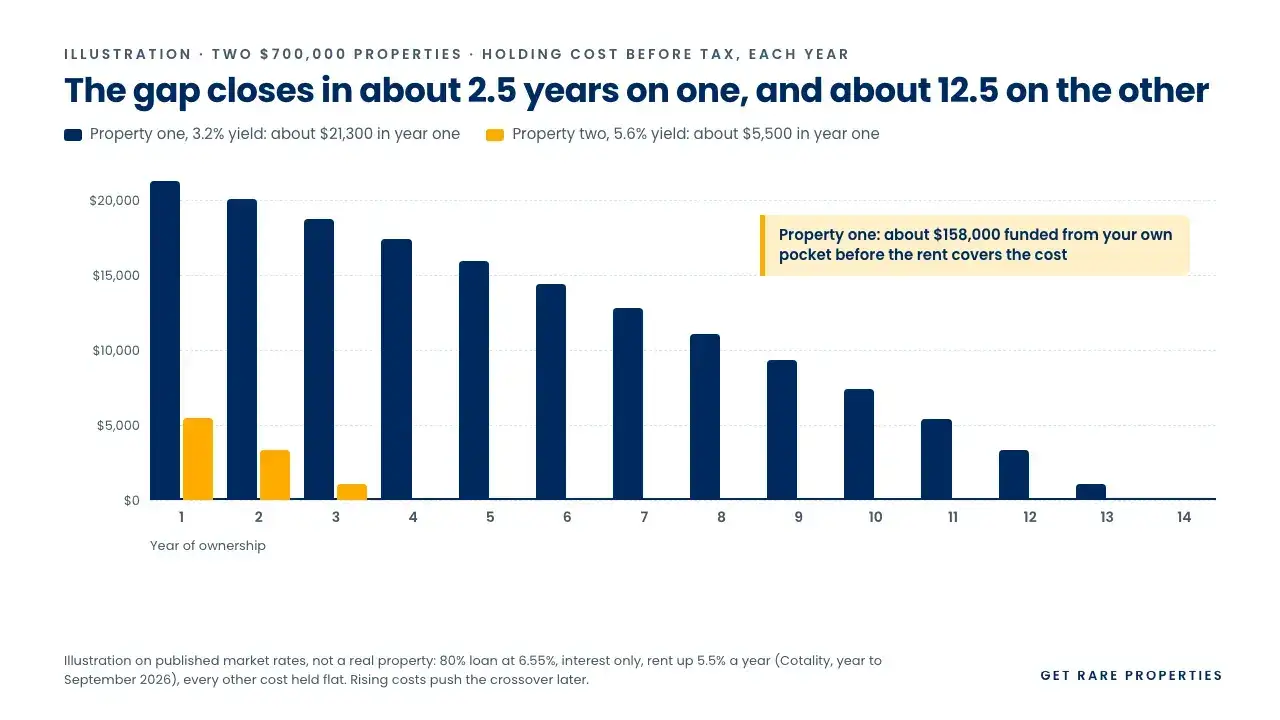
Short answer: the holding cost of an investment property is what it costs you each year, out of your own pocket, after the rent comes in. In a $700,000 illustration with an 80% loan at 6.55%, a 3.2% yield costs about $21,300 a year to hold. If rent grows 5.5% a year and costs stay flat, that gap takes about twelve and a half years to close, and about $158,000 to fund along the way. The Crossover Test asks one question before you buy: how many years will you fund the gap, and can you carry it that long?
Fast facts: Australian rental yields, rates and the 2027-28 rule (Cotality, RBA, the Act: 2026)
- The national gross rental yield was 3.85% at 30 September 2026, the highest since August 2019, up from 3.61% a year earlier. (Source: Cotality Quarterly Rental Review, published 9 October 2026.)
- National rents rose 5.5% over the year to September 2026, but only 0.5% in the September quarter, while the yield went from 3.7% at June to 3.85%. (Source: Cotality Quarterly Rental Reviews, 9 July and 9 October 2026.)
- National home values fell 1.1% in September 2026, a sixth straight monthly fall. (Source: Cotality Home Value Index, results to 30 September 2026.)
- The cash rate target rose to 4.85% on 3 November 2026, the fifth rise this year, after 4.60% from 30 September. (Source: Reserve Bank of Australia, Monetary Policy Decisions of 29 September and 3 November 2026.)
What holding costs on an investment property actually include
Holding costs are the running costs of owning an investment property, set against the rental income it earns. The biggest line is the interest on the loan. Then come council rates, landlord insurance, your property manager's fees, maintenance and repairs, strata or body corporate fees on a unit, land tax where it applies, and vacancy, the weeks a property sits empty between tenants. Stamp duty and the other buying costs are paid once, so they sit outside it.
When the rent is lower than all of that, you fund the difference from your own income. That difference is the holding gap.
Why a seven-year-high rental yield can mislead you
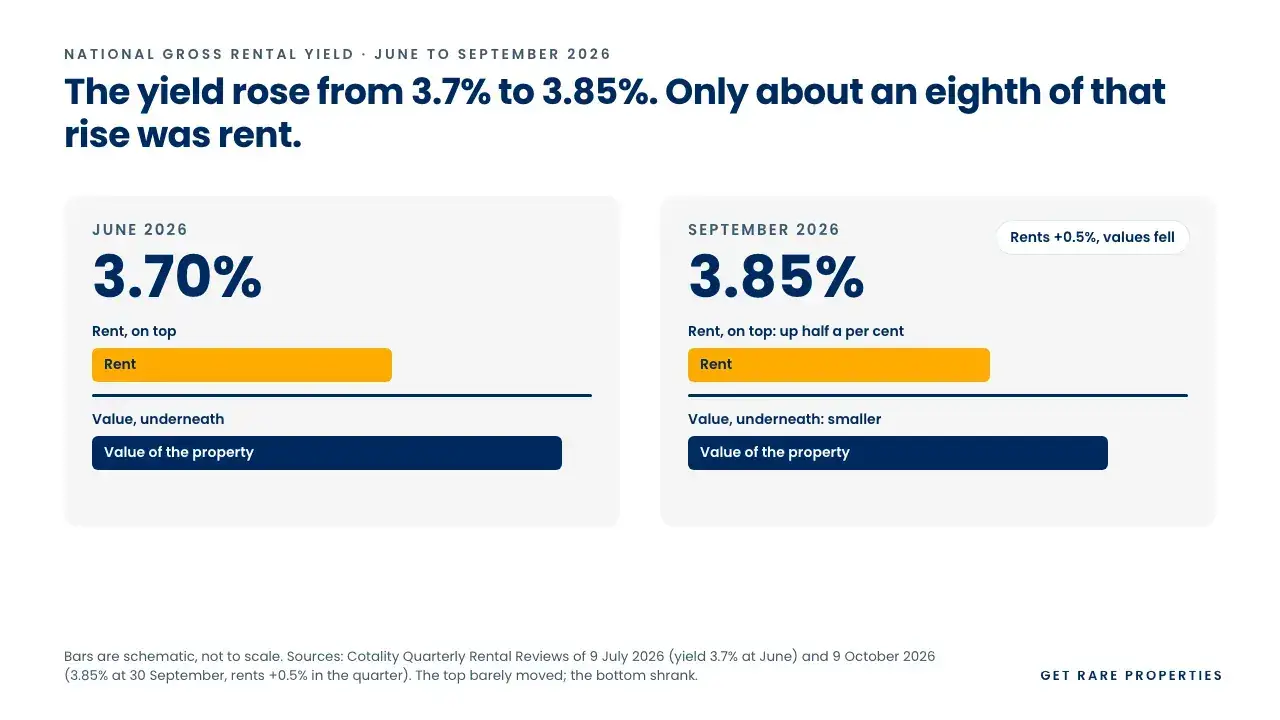
A yield is a fraction: the rent sits on top, and the value of the property sits underneath.
Over the year to September, rents rose 5.5% and values went nowhere, according to Cotality's September quarter rental review, so that year's rise in yield was mostly rent.
Since June it is different. The yield went from 3.7% to 3.85% while rents rose half a per cent, and national values fell for a sixth straight month in September. The top barely moved, the bottom shrank, and the fraction improved anyway.
Nobody sent you more money for that part. You just own a bigger share of something worth less. It is like being told you now hold a larger slice of a company that shrank.
A better yield is still a better yield, whatever caused it. That is partly true. But if you use that number to choose which property to buy, you are letting a fall in somebody else's capital value choose your asset for you. That is the mistake this whole test exists to catch.
Investment property holding costs after the 2027-28 negative gearing change
General information only. We're licensed buyer's agents, not financial or tax advisers, so please check anything that affects your money with your own adviser.
From the 2027-28 income year, if you buy an established residential property after Budget night, 12 May 2026, a loss on it no longer comes off your salary. It comes off later income from residential property, or a future capital gain on residential property, and it carries forward. That is what the Act now says about negative gearing for property bought after that date.
Negative gearing is not gone. The loss just cannot reach your wage any more. New builds are treated differently, and the definition of new is not final yet. If you bought before Budget night, none of this reaches you. You can read the rule yourself in the Treasury Laws Amendment (Tax Reform No. 1) Act 2026, Schedule 2.
Two investment properties at the same price: a worked example
This is an illustration built on published market rates. It is not a real property, and nobody in it is a client.
Two properties, both $700,000. The first has a gross yield of 3.2%: better street, better land, about $22,400 a year in rent. The second has a yield of 5.6%: further out, a bigger block, about $39,200 a year in rent. Same deposit on both, the same 80% loan at 6.55%. The rate is August's 6.3% large-bank rate for new investor loans in the Reserve Bank's lending rates table F6, plus the September rise.
| Line, per year | Property one, 3.2% yield | Property two, 5.6% yield |
|---|---|---|
| Price | $700,000 | $700,000 |
| Rent | about $22,400 | about $39,200 |
| Interest, 80% loan at 6.55% | about $36,700 | about $36,700 |
| Rates, insurance, management, maintenance, vacancy | about $7,000 | about $8,000 |
| Holding cost, before tax | about $21,300 | about $5,500 |
| Years until rent covers the cost, rent up 5.5% a year | about 12.5 | about 2.5 |
Illustration only, on published market rates: Cotality rents to September 2026, RBA table F6 for August 2026 plus the September rise. Interest only, costs held flat.
Now put the 2027-28 rule on the first one. Under the old rules the loss was a tax deduction against your salary. On a salary of around $170,000, the tax refund brought its cost down to about $13,000 a year. That uses the 37% bracket plus the 2% Medicare levy, from the ATO's resident tax rates. Under the new rule it is the full $21,300, until there is residential property income or a residential capital gain to use the loss against.
That is about $8,000 a year more out of your pocket, because the rule changed. Anyone still using the old number to decide what they can afford is short by about $60,000 in cash before that gap closes.
The example's 6.55% was set before the Reserve Bank's 3 November rise to 4.85%. On today's rates the holding cost is higher and the crossover comes later, not sooner.
The Crossover Test: four inputs, one year
On holding cost alone the second property wins, and I understand the pull. But rent does not stay still. If rent grows, the gap closes. So the number that decides this is not year one's cost. It is the year the gap reaches zero, and whether you can make it that far.
I call it the Crossover Test. Four inputs, one number: the year the property starts paying for itself.
- What the property costs you to hold, after the 2027-28 change, not before it.
- The rent, today.
- What you are assuming rent grows at. Be more cautious than the national figure for your own suburb.
- What you can carry out of your own income, every year, without changing how you live. If that is the one making you uncomfortable, that is the test working.
To run it, take the rent, grow it by your rate, year by year, and count the years until it covers the cost.
On the first property, at 5.5% rent growth, the gap closes in about twelve and a half years. Add up every year until then and that is the $158,000. On the second, about two and a half years. That is a real answer, and it does not favour me.
Where rent did not move at all: the case against my own numbers
Now the strongest argument against my own numbers, because I would rather you saw it now than in year four.
Last year I named seven Melbourne suburbs under $750,000. When I graded them in October, the rent had been flat for twelve months in three of them. Not slow. Flat. Buy into one of those assuming 5.5% rent growth, and your crossover year just became never. The property did not fail. The assumption did.
The sum is also generous in a second way. It holds every cost flat. In our own model of the same example, letting rates, insurance and maintenance rise 3% a year moves the crossover from about twelve and a half years to about 14.6. The loan matters as much as the property: on a 60% loan, the same model gives about 9.7 years. Same street, same rent. The plan decides the year.
I have had the other side of this myself. In 2015 I bought an off the plan unit in Campbelltown, in Sydney's southwest, at a 5% yield, assuming 5% growth. The reasoning was the hospital and its jobs. For about six years, that is what happened. Then the growth stalled. I was right about the demand. What I did not think hard enough about was the supply: the same thing that made it obvious to me made it obvious to developers, and a lot more apartments got delivered into it. It still rents well and costs me almost nothing to hold.
Easy to hold is not the same as growing. Whichever number you lean on, rent or growth, run it at the one you would be uncomfortable with, and run rent at your suburb's number, not the national one. If you have already bought into something like that, watch your area's rents, and the questions to ask before you sell are the place to start.
Cash flow is not a strategy. It is a constraint.
Cash flow does not build the wealth. It buys you the years in which something else does.
Think about a diver. How long you can stay down decides what you can reach, and it has nothing to do with how fast you swim. Holding power is the air in the tank, and the property is what you went down there for. Run out of air at thirty metres and you do not get to choose how you come up. You come up fast, and you sell into whatever market is waiting. That is not a strategy. It is the market deciding for you.
For the long-term investor, the yield is not a ranking of properties. It is one input into how long you can stay down.
Run The Crossover Test On Your Own Numbers At The Free WorkshopBuy, Wait or Sell: free, 75 minutes, online, with live questions.
Three ways to shrink the holding gap
There are three honest answers once you have your crossover year.
- Fund the better asset for as long as it takes, if the gap sits inside what you can carry.
- Buy the yield property with your eyes open, knowing what it trades away.
- Buy the better asset, smaller.
The third one is the move that shrinks the gap. Take the same first property at $550,000 instead of $700,000, put the same deposit in, and the annual holding cost drops from about $21,300 to about $15,300. That is about $6,000 a year less. Same street, same kind of land, less of it.
A smaller house in a good street usually beats a bigger house in a bad street, because the land is what appreciates. Our fee is a flat fee, tiered by purchase price bracket. Both of these prices sit in the same bracket, so this answer does not change what we earn. I would still rather you bought that than the cheaper thing you can service on paper.
What I would not do with my own money at these numbers
I would not buy new just to keep the deduction. The tax treatment is one line in that decision, not the decision, and new against established deserves its own comparison before you sign.
What I would do is work out the crossover year on every property before making an offer. Not because the number is magic, but because if you cannot produce it, you have not decided anything. You have just liked something.
Buy, wait or sell: run the holding question on your own property
Run the Crossover Test and you get a year. If it sits inside what you can carry, you have your answer. If not, what you have is a budget to change, not a strategy to change.
Our free 75-minute session, Buy, Wait or Sell, is where your own numbers go in, so you leave knowing your own holding gap before you open a single listing. Everyone who stays to the end gets a print copy of my book, The Property Wealth Blueprint, posted to them.
Save my seat at Buy, Wait or SellFree, 75 minutes, online. Register and the replay comes to you if you can't make it live.
Frequently asked questions
What costs are included in holding an investment property?
Holding costs are the yearly running costs of an investment property minus the rent it earns: interest, council rates, insurance, property management, maintenance and vacancy. In a $700,000 illustration with an 80% loan at 6.55% and a 3.2% yield, they come to about $21,300 a year before tax.
What is the Crossover Test?
The Crossover Test is a four-input check Rasti Vaibhav uses before an offer: the holding cost, today's rent, an honest rent growth rate for that suburb, and what you can carry each year. Grow the rent year by year and count the years until it covers the cost.
How long does it take for rent to cover the holding costs?
It depends on the gap and how fast rent grows. In the $700,000 illustration, at 5.5% rent growth with costs held flat, a 3.2% yield takes about twelve and a half years and a 5.6% yield about two and a half. At zero rent growth the gap never closes.
Does the 2027-28 negative gearing change apply to property I already own?
Not if you signed the contract before 7:30pm ACT time on 12 May 2026. The change applies from the 2027-28 income year to established residential property bought after that, and new builds are treated differently. Check how it applies to you with your own tax adviser.
Is a higher rental yield always better for an investor?
No. A higher yield makes a property easier to hold, but a yield can rise because values fell rather than because rent rose.
How can you reduce the holding cost of an investment property?
One way is to buy the better asset, smaller. In the illustration, the same street at $550,000 instead of $700,000, with the same deposit, cuts the holding cost from about $21,300 to about $15,300 a year.
General information only. We're licensed buyer's agents, not financial or tax advisers, so please check anything that affects your money with your own adviser. Nothing here is a recommendation to buy or sell any particular property. The worked example is an illustration on published market rates, not a real property.
Video transcript: Can You Actually Afford to Hold Your Investment Property?
Figures and statements reflect what was said at the time of recording. Transcript adapted from the video captions, with punctuation and paragraph breaks adjusted for readability.
Read the full transcript (2,124 words)
If you're picking your next property by its yield, you're about to pick it with the wrong number. Rental yields just hit a seven year high, 3.85 per cent, the best since 2019. But since June, only about an eighth of that rise is your rent. The rest came from values falling. On my own list, three suburbs saw zero rent growth for twelve months. Zero. I'll show you the Crossover Test. It tells you how long you'd fund a property, and whether you can, before you buy it. It lands at about eight minutes, then the move that shrinks your holding gap.
Here's an example: a seven hundred thousand dollar investment property in a good street costs you about twenty one thousand three hundred dollars a year to hold on current rates, out of your own pocket. Even with rents rising steadily, you fund that gap for about twelve and a half years. About a hundred and fifty eight thousand dollars, all up. Cash flow is not a strategy, it's a constraint. Can you carry that? I've bought twenty two properties with my own money. I still hold every one, so holding is the part I know. I'm a licensed buyer's agent, and our fee goes up with the purchase price.
So take this the right way: for a lot of you, the answer here is spend less. So what's inside that seven year high? A yield is a fraction. The rent sits on top. The value of the property sits underneath. Over the year, rents rose 5.5 per cent and values went nowhere, so that was mostly rent. Since June it's different. The yield went from 3.7 to 3.85 per cent while rents rose half a per cent. Values fell. The top barely moved, the bottom shrank, and the fraction improved anyway. Nobody sent you more money for that part. You just own a bigger share of something worth less.
It's the same as being told you now hold a larger slice of a company that shrank. And you might be thinking, fine, a better yield is a better yield, whatever caused it. Partly true. But if you use that number to pick which property to buy, you're letting a fall in somebody's capital value choose your asset for you. That is the mistake this whole video is about. And from 2027, that mistake gets harder to resist, because a tax rule changed. Before I show you how, two quick things, because this touches tax and money. I'm a licensed buyer's agent, not a financial or tax adviser.
Everything here is general information only, so please check anything that affects your money with your own adviser. Nothing here is a recommendation to buy or sell any particular property. I run an independent buyer's agency, with no commissions from developers or agents. The only person paying us is the person we're buying for. Two things changed in 2026. The cash rate is 4.60 per cent, after four rises. as we speak. And from the 2027-28 income year, if you buy an established residential property after Budget night, the twelfth of May, a loss on it no longer comes off your salary.
It can only come off later residential property income, or a future capital gain on residential property, and it carries forward. New builds are treated differently, and the definition of new isn't final yet. If you bought before Budget night, none of this reaches you. Negative gearing is not gone. The loss is not gone. It just cannot reach your wage any more. And your clock is running. Buying in the next six months? Find a property in March, learn in April you can't carry it, and you've lost months. Run this test tonight, not after an offer. One of the next two properties just got about eight thousand dollars a year more expensive. Watch.
Here's that number, beside a second property at the same price. An illustration, on published market rates. The first has a gross yield of 3.2 per cent. Better street, better land. About twenty two thousand four hundred a year in rent. The second has a yield of 5.6 per cent. Further out, bigger block. About thirty nine thousand two hundred. Same deposit on both, same loan. An eighty per cent loan at 6.55 per cent is about thirty six thousand seven hundred a year in interest. Then rates, insurance, management, maintenance, and the weeks it sits empty. Run it. The first costs you about twenty one thousand three hundred a year to hold.
The second costs you about five thousand five hundred. Now put the 2027 rule on the first one. Under the old rules, on a salary of around a hundred and seventy thousand, the tax refund brought its cost down to about thirteen thousand a year. Under the new rules, it's the full twenty one thousand three hundred. About eight thousand a year more out of your pocket, because the rule changed. This is where people get stuck. They're still using the old number to decide what they can afford, and they're short by about sixty thousand dollars in cash before that gap closes. And it's tempting to pick the second property. I understand why.
But there's a question worth asking before you pick, and it changes the answer. How long would you have to fund that gap? Because rent doesn't stay still. If rent grows, the gap closes. So the number that decides this isn't what the property costs you in year one. It's the year the gap reaches zero, and whether you can make it that far. I call it the Crossover Test. Four inputs, one number: the year the property starts paying for itself. One. What the property costs you to hold, after the 2027 change, not before it. Two. The rent, today. Three. What you're assuming rent grows at.
Nationally it has been 5.5 per cent over the year, and only half a per cent in the last three months. Be more pessimistic than the national number for your own suburb, and I'll show you why in a minute. Four. What you can carry out of your own income, every year, without changing how you live. If that's the one making you uncomfortable, that is the test working. Screenshot those four: that's the Crossover Test. Then pause the video and open the calculator on your phone. Take the rent, grow it by your rate, year by year, and count the years until it covers the cost. I'll wait.
And if you get a 12 year crossover on an established property, you might be wondering: what if I bought new instead? The tax treatment differs, so the crossover changes too. That comparison is a seven row table I run live in the session. If you're choosing between new and established, see it before you sign. On the first property, at 5.5 per cent rent growth, the gap closes in about twelve and a half years. Add up every year until then and that's the hundred and fifty eight thousand I opened with. On the second, about two and a half years. That is a real answer, and it does not favour me.
On these numbers the yield property is dramatically easier to hold. If you're sitting there thinking twelve years is a long time to fund anything, you're right. Now I'm going to show you the strongest argument against the numbers I just gave you. And if you're thinking, wait, is he arguing against himself? Yes. I'd rather you saw it now than in year four. Last year I named seven Melbourne suburbs under $750,000. When I graded them in October, the rent had been flat for twelve months in three of them. Not slow. Flat. The full grading is in my scorecard video.
Buy into one of those assuming 5.5 per cent rent growth, and your crossover year just became never. The property didn't fail. The assumption did. I've had the other side of this. In 2015 I bought an off the plan unit in Campbelltown, in Sydney's southwest, at a 5 per cent yield, assuming 5 per cent growth. The reasoning was the hospital and its jobs. For about six years, that's what happened. Then the growth stalled. I was right about the demand. What I didn't think hard enough about was the supply. The same thing that made it obvious to me made it obvious to developers, and a lot more apartments got delivered into it.
It still rents well and costs me almost nothing to hold. Easy to hold is not the same as growing. So whichever number you're leaning on, rent or growth, run it at the one you'd be uncomfortable with, and run rent at your suburb's number, not the national one. And if you've already bought into something like that, I know how that lands. Watch your area's rents. If you screenshot one thing from this video, make it this. Cash flow is not a strategy. It is a constraint. It does not build the wealth. It buys you the years in which something else does. Think about a diver.
How long you can stay down decides what you can reach. It has nothing to do with how fast you swim. Holding power is the air in the tank, and the property is what you went down there for. And if you run out of air at thirty metres, you don't get to choose how you come up. You come up fast, and you sell into whatever market is waiting for you. That isn't a strategy. It's the market deciding for you. If that changed how you see this, the session goes further, link below. Here's the move that shrinks your holding gap: buy the better asset, smaller.
It drops your holding cost by about six thousand dollars a year. Take that same first property at five hundred and fifty thousand instead of seven hundred, put the same deposit in, and the annual cost drops from about twenty one thousand three hundred to about fifteen thousand three hundred. Same street. Same kind of land. Less of it. Screenshot this one. It's one of three answers: fund the better asset for as long as it takes, buy the yield property with your eyes open, or this. A smaller house in a good street usually beats a bigger house in a bad street, because the land is what appreciates.
Our fee is a flat fee, tiered by purchase price bracket. Both of these sit in the same bracket, so this answer doesn't change what we earn. I would still rather you bought that than the cheaper thing you can service on paper. Here's what I wouldn't do with my own money, at these numbers. I wouldn't buy new just to keep the deduction. The tax treatment is one line in that decision, not the decision. And I wouldn't treat a loan approval as the answer. A bank tests today's repayments, with a buffer. It doesn't ask how many years you'll fund the gap. That's your question, not the bank's.
What I would do is work out the crossover year on every property before I made an offer. Not because the number is magic, but because if you can't produce it, you haven't decided anything. You've just liked something. This is for you if you own one or two and you're working out whether you can carry the next. Or if you've been told rents will cover it and nobody showed you the year that happens. Not you, if you're flipping in twelve to twenty four months. So run the Crossover Test and you get a year. If it sits inside what you can carry, you have your answer.
If not, what you have is a budget to change, not a strategy to change. Because cash flow is not a strategy. It is a constraint. Our free seventy five minute session, Buy, Wait or Sell: that's where your own numbers go in. You watch two portfolios run live, you see the seven rows of new against established, and you work out the holding question on your own property yourself, so you leave knowing your own holding gap before you open a single listing. Everyone who stays to the end gets a print copy of my book, The Property Wealth Blueprint, posted to them.
If you want to go further after that, there's a free fifteen minute readiness check, and we often tell people not yet. The link is in the description. And coming up on this channel: the proposed tax on trusts, who it would really hit, and who it wouldn't. Until then, find your crossover year.
General information only. We're licensed buyer's agents, not financial or tax advisers, so please check anything that affects your money with your own adviser.

About the author
Rasti Vaibhav is the founder of Get RARE Properties, an independent buyer's agency for property investors. He is a CFA Charterholder and spent more than nine years managing institutional portfolios at Westpac and AMP Capital before founding the firm in 2020. He sits on the REINSW Buyers' Agent Chapter Committee and is the author of The Property Wealth Blueprint.
Get RARE Properties is Featured On
Get RARE Properties is Featured On
Related Articles
Related Articles