
Australian Financial Review, news.com.au, Daily Mail Australia, realestate.com.au, Canstar and Property Insights with Mark Bouris. Featured in more than 40 publications since 2022: explore our media appearances.
Home / Insights / Portfolio Strategy / Should I Sell My Investment Property
Should I Sell My Investment Property?
The four questions I ran on my own
Nobody can tell you whether to sell from an article, including me. What you can do is stop asking whether it is a good property, and answer four questions instead. I have bought 22 properties with my own money and never sold one. I am running these four on one of mine right now.
What is the sell, wait or hold decision?
It is the choice every investor faces when a property stops doing the job it was bought to do: sell it, hold it on purpose, or wait and decide later. It is not the same as asking whether the property is good. It is a question about your whole position.
🎥 Watch first: My Investment Property Rents Well. So Why Am I Considering Selling? (12:20): the same four questions, run on one of my own properties with the numbers on screen.
Fast facts
What the Act actually says, and what the market is doing
- The 2027 transition defers the gain, it does not trigger it. Where the transition rules apply, a property held on 30 June 2027 is broadly treated as sold and bought back at market value, with the gain dealt with when you really sell. (Source: Treasury Laws Amendment (Tax Reform No. 1) Act 2026, s112-155.)
- Grandfathering runs from the contract date, not settlement. Contracts exchanged before 7.30pm on 12 May 2026 sit in a different position. (Source: the same Act, read from the Federal Register of Legislation.)
- The change applies from the 2027-28 income year for established property bought after that cutoff. New builds are treated differently. (Source: the same Act.)
- Values have been falling while rents have risen, which is why investors are getting two opposite signals at once. (Source: Cotality Home Value Index, as at 31 August 2026.)
Get RARE Properties is Featured On
Get RARE Properties is Featured On
Short answer: nobody can tell you whether to sell your investment property from a video or an article, including me. What you can do is stop asking "is this a good property" and answer four questions instead: what was it for, what does it cost to hold, what does another year cost, and what would have to change your mind. I have bought 22 properties with my own money and never sold one. I am running these four on one of mine right now.
Key takeaways
- A deadline does not help you decide anything. It makes you transact. Almost every piece of advice arriving in investor inboxes right now has 1 July 2027 attached to it.
- 1 July 2027 is not the sell-by date it sounds like. Where the transition rules apply, an investment property held on 30 June 2027 is broadly treated as sold and bought back at market value, and the capital gain is deferred until you actually sell. There are carve-outs, new builds among them.
- "Has it been good to me" is the wrong question. "Would I buy it again today, at today's price, knowing what I know now" has no loyalty in it.
- Waiting is not free just because it involves doing nothing. Price the year in both directions before you call it a decision.
- A property that looks fine on cash can still be expensive. Mine does not cost me money. It costs me borrowing capacity, and that is a portfolio problem, not a property problem.
Contents
- Why you are being asked this right now
- Question one: what was this investment property actually for?
- Question two: what does it cost you to hold?
- Question three: what does another year cost you?
- What 1 July 2027 actually does
- Question four: what would have to be true to change your mind?
- The honest case for selling before the date
- A property problem, or a portfolio problem?
- Five tests you can run this week
- Questions investors actually ask
Why you are being asked this right now
Property prices have been falling while rents have kept rising, so investors are getting two different signals at once. One says the asset is going backwards. The other says the tenant is fine.
Then add the tax change, and the advice arriving in your inbox stops being advice. It becomes a countdown. Sell before June. Act before the change.
A deadline does not help you decide anything. It just makes you transact.
So here are four questions that do. I will use one of my own investment properties, a unit in south west Sydney, to show the working. It rents well. It costs me almost nothing to hold. I am still questioning whether to keep it.
Question 1: What was this investment property actually for?
Not what it has become. What you bought it to do. Growth, rental income, a deduction, or somewhere to park cash at the time. Be honest about which, because the rest of the review is measured against it.
Mine was bought for growth in 2015, and the reasoning was a hospital: jobs, staff who need to live nearby, and infrastructure arriving ahead of the suburbs around it. For about six years that is exactly what happened.
Here is the part I got wrong. I was right about the demand. What I did not think hard enough about was the supply. The same thing that made that location obvious to me made it obvious to developers, and a lot more apartments got delivered into it.
So underneath question one sits the question that actually settles it: would I buy it again today, at today's price, knowing what I know now?
That is a much harder question than asking whether it has been good to me, because it has no loyalty in it. It does not care what you paid, how long you have held it, or how you feel about the decision you made.
And a no is not an instruction to sell. It is a reason to go and price what selling would actually cost you. Property is cyclical, but "it will come good eventually" is not a good enough reason on its own to hold something you would not buy today.
Question 2: What does it cost you to hold?
Before anything else, work out whether the 2027 change reaches you at all.
If you exchanged contracts before the Budget night cutoff of 7.30pm on 12 May 2026, that property is grandfathered. It is the contract date that matters here, not settlement. If that is you, do not skip ahead, because question three still applies.
If you bought an established property after that cutoff, the change applies from the 2027-28 income year. New builds are treated differently, and the detail of what the 2026 reforms changed sits on its own page, because it is a bigger subject than this one.
What it does is this. If your deductions are higher than your rent, that excess does not disappear. It can no longer reduce your salary the way it can today. Instead it carries forward, and it can be used against later residential property income or capital gains. If the mechanics of how negative gearing actually works are new to you, start there first.
Which means you need two numbers on the same property. What it costs you today, and what it costs once those deductions cannot reach your salary.
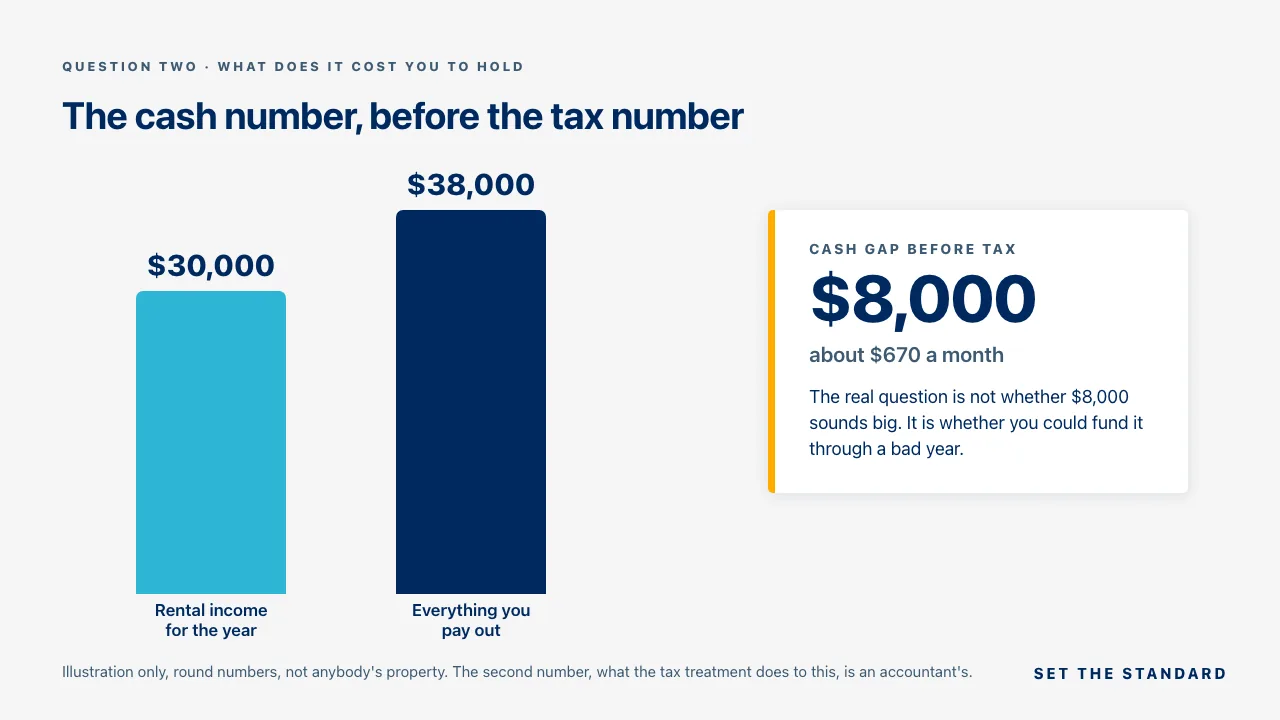
| Illustration only, round numbers | Amount |
| Rental income received for the year | $30,000 |
| Everything you pay out for the year, including the mortgage | $38,000 |
| Cash gap before tax | $8,000 |
| Same gap, per month | about $670 |
Round numbers, and not anybody's property. That is the cash number. The second number is what the tax treatment does to it, and that one belongs to your accountant, not to me.
The real question is not whether $8,000 sounds big. It is whether you could fund it through a bad year.
Now the same test on mine. I bought in 2015, so this one is grandfathered and the change does not reach it. Separately, it roughly breaks even on cash, which is not the same thing as its taxable position. That is one property, not a general claim.
A lot of the current discussion assumes a heavily negatively geared property, and yours might not be one. Do the sum before you react to the headline.
Question 3: What does another year cost you?
This is the one almost nobody asks.
Holding deliberately and avoiding a decision look exactly the same on paper. The property cannot tell the difference. You can. And it is very easy to postpone a decision and call it holding.
Some of the costs of waiting never appear on a bill. So price the year in both directions.
| If you sell | If you hold |
| Real estate agent fee, marketing, and the selling costs nobody quotes you upfront | The cash gap for another year |
| The capital gains tax consequences | What it does to your borrowing |
| Stamp duty again, if you buy another property | Another year of whatever made you consider selling |
| What the money left over could do, on return, risk and flexibility | Another year of whatever made you buy it |
Neither column is automatically right. But one of them is not free just because it involves doing nothing.
What 1 July 2027 actually does
This is where the deadline distorts the comparison. Waiting suddenly feels expensive and selling feels urgent.
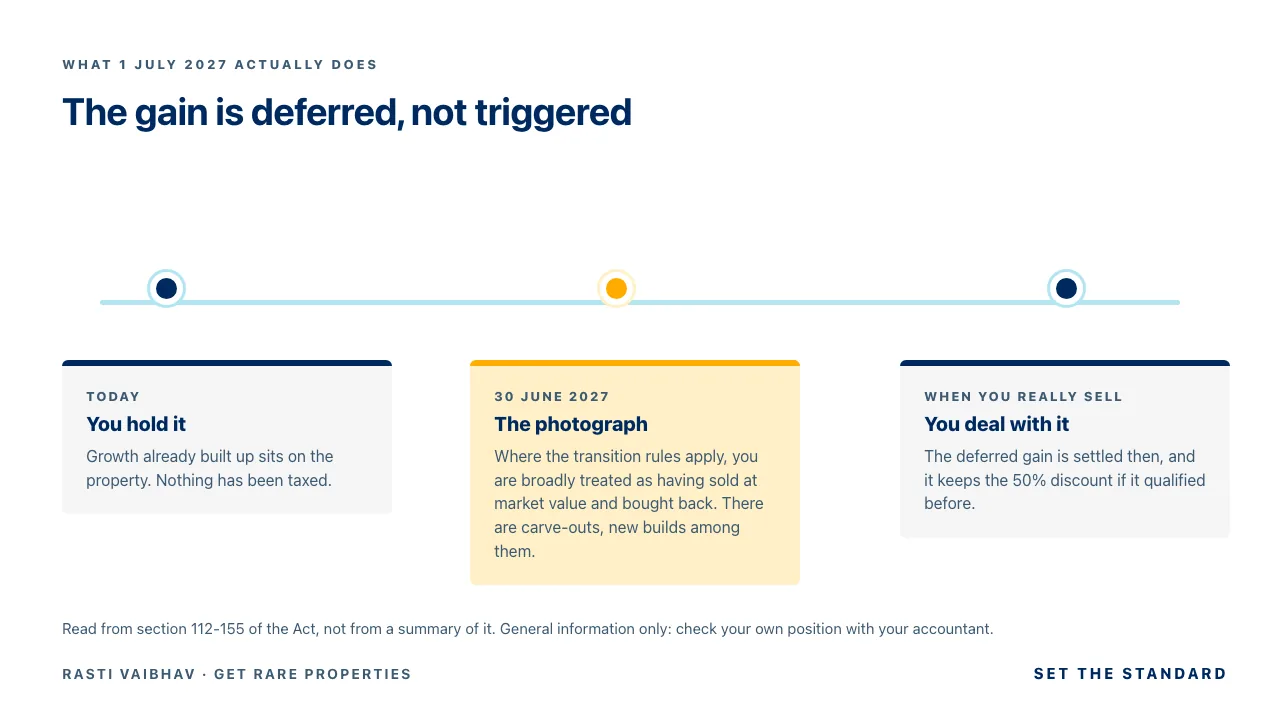
If you take one thing from this article, take this one.
For an investment property you are holding on 30 June 2027, where the transition rules apply, you are broadly treated as though you sold it that day at market value and bought it back the next morning. There are carve-outs, new builds among them, so check yours.
You do not actually sell anything. It is more like the tax office taking a photograph of what the property is worth that day and putting the photo in a drawer until you really sell.
You do not pay tax on it then. The capital gain is deferred. You deal with it when you actually sell. And if it qualified for the 50% capital gains tax discount before, it can still get it.
So on the growth you already have, selling before that date is not what preserves the treatment. Growth after it gets indexation instead, and a minimum 30% rate of tax that your accountant will walk you through.
That is read from section 112-155 of the Act, not from a summary of it.
Two more details that get missed. You do not necessarily need a valuation on 30 June. The Act allows an apportioning method instead, and you do not have to choose between them until the year you actually sell. And the deemed sale does not restart the twelve-month clock for the discount.
So a great deal of the pressure investors feel right now is pressure to protect something that is already protected.
Do not assume you need to sell your investment property before July 2027 just to protect the treatment on the gain you have already built up. Check that with your accountant, before a tax deadline turns into a property decision.
Question 4: What would have to be true to change your mind?
Write it down now, while you are calm, before the next headline. A number, a date, or a trigger. Rent drops below this. Vacancy goes above that. And be clear what the trigger does: it starts a review, not an automatic sale.
The version of you reading a headline in March is not the version of you reading this now. One of you is thinking. The other is reacting. Question four is how the thinking one leaves instructions for the reacting one.
And if you cannot write a trigger down at all, that is useful too. It usually means the honest answer to question one was never clear in the first place.
The honest case for selling before the date
I want to be straight about this, because skipping it would be dishonest.
There are good reasons to sell an investment property. Concentration in one property market. A property that has failed its job for years rather than months. A cash gap you cannot fund through a bad year. A life change that needs the money. And for some investors, a genuine change in the after-tax economics of holding from 2027-28 onward, which is exactly why the second number in question two is an accountant's number and not a headline's.
What I am arguing against is narrower than "do not sell". It is this: protecting a discount you already have is not one of those reasons.
A property problem, or a portfolio problem?
When you have answered all four, zoom out, because you are not really deciding about a property. You are deciding about a position.
Almost everybody who asks me this is worried about cash flow, and that is legitimate. But if you bought for growth, cash flow is what keeps you in the game long enough for the growth to happen. That tension is older than this policy change, and the myths about growth and cash flow are worth reading beside this.
So the question is not only whether the property is working. It is: where am I now, where am I going, and is this property on that path or in the way?
For mine, the honest answer is that the south west Sydney one is not costing me money. It is costing me borrowing capacity. That is a portfolio problem, not a property problem, and it is why I am talking to my mortgage broker and my accountant rather than a real estate agent.
If your problem is cash flow rather than performance, check whether there is another lever before you sell. Could the loan be restructured? Could you refinance and put usable equity to work? Those are questions for your broker, and the levers that increase borrowing capacity are worth exhausting before you pay transaction costs you cannot get back.
That is how we start with clients too. A property portfolio review before anybody talks about buying. We are buyer-paid, with no developer or selling agent commissions, so the review does not begin with a property we need you to buy. You can read what that has looked like for other families rather than take my word for it.
Five tests you can run this week
- The purpose test. Write the original job of the property in one sentence. If it takes three, the answer to question one was never clear.
- The repurchase test. Would you buy it again today at today's price? "It has been good to me" is not an answer.
- The funding test. Divide the annual cash gap by twelve, then ask whether you could fund that through a year with a vacancy and a repair in it.
- The grandfathering check. Find the contract date, not the settlement date, for every property you own.
- The trigger test. Write one number and one date that would start a review. If you cannot, go back to test one.
Questions investors actually ask
Should I sell my investment property before July 2027?
Not for the reason most people are being given. Where the transition rules apply, a property held on 30 June 2027 is broadly treated as sold and reacquired at market value, with the gain deferred until the real sale, and growth already built up keeps its existing treatment if it qualified before. There are carve-outs, including new builds. Your own position is an accountant's question, and the date on its own is not a reason to transact.
Should I sell my investment property or keep it?
That depends on four things, in this order: what you bought it for, what it costs you to hold, what another year costs you, and what would have to change for you to act. Run all four before you ask a real estate agent for an appraisal, because an appraisal answers a different question.
How long should you keep an investment property?
There is no correct number of years. The test is whether the property is still doing the job you bought it to do, and whether you would buy it again today at today's price. Time held is a fact about the past, not an argument about the future.
How do I avoid capital gains tax when I sell an investment property?
I am not going to answer that one, and you should be careful with anyone who does. We are licensed buyer's agents, not tax advisers. What I can tell you is that the timing pressure around 1 July 2027 is widely misunderstood, and your accountant is the person to ask what applies to you.
What is the 1% rule in property investing?
It is an American screening shortcut that asks whether monthly rent is about 1% of the purchase price. It almost never holds in Australian capital cities and it is not how we assess a property. The four questions above are the replacement.
Does it matter if my investment property is tenanted when I sell?
It changes who can buy it, because an existing lease travels with the property and narrows the buyer pool toward investors rather than owner-occupiers. Your property manager holds the lease dates you need, and the mechanics for your market are a question for the selling agent you appoint, which is a different role from ours.
My property breaks even on cash. Is that good enough?
Breaking even on cash is not the same as working. Mine roughly breaks even and is still under review, because the cost showing up is borrowing capacity rather than cash. Ask what the property does to the rest of your position, not only to your bank account.
Should I just never sell?
I have never sold one of mine, so I understand the instinct, but "never sell" is a slogan rather than a strategy. The four questions are there precisely so the decision is made on purpose rather than by default in either direction.
What I am not doing with mine
I am not selling it this financial year to beat a date, and I am not tipping more money in to make the cash flow look tidier. I am getting the review done first: what it would actually net if I sold, and what each option does to my borrowing.
You have the questions. What you do not have yet are your numbers.
Watch the four questions run on real portfolios
Reading the questions is not the same as watching them answered. In our free online session, Buy, Wait or Sell, we run them on real portfolios with real numbers on screen. Sometimes the answer is buy. Sometimes it is wait. Sometimes it is sell. And sometimes it is to do nothing at all.
Save your seat for Buy, Wait or Sell
General information only. We're licensed buyer's agents, not financial or tax advisers, so please check anything that affects your money with your own adviser.
Do not decide on a deadline you have not read
Watch the four questions run on real portfolios, with real numbers on screen. Free, and the replay runs for 72 hours.
No fluff, just strategy.
Save my seat for Buy, Wait or Sell
About the author
Rasti Vaibhav is the founder of Get RARE Properties, an independent buyer's agency for property investors. He is a CFA Charterholder and spent more than nine years managing institutional portfolios at Westpac and AMP Capital before founding the firm in 2020. He sits on the REINSW Buyers' Agent Chapter Committee and is the author of The Property Wealth Blueprint.
Related Articles
Related Articles