
Short answer: there is no universal number of investment properties, and anyone who gives you one has skipped the only three steps that produce it. For the household in the video below it came out at four investment properties owned outright. Move one assumption and the same person needs five. The count is never the input. It falls out of three questions about your own position.
Watch first: I run the three steps on a real household's figures, with every number on screen. Eleven minutes. If it is useful, subscribe and the next one finds you.
I am Rasti Vaibhav, a CFA Charterholder and a licensed buyer's agent. I spent more than nine years managing institutional portfolios at Westpac and AMP Capital before I started buying property for clients, and this is the one question I am asked more than any other.
The question is usually asked backwards
"How many investment properties do I need to retire?" is a question about a count.
Retirement is not a count. It is a passive income you have to fund, starting on a date, for a number of years nobody can tell you in advance.
Every retirement number you have been handed, from a super fund, a calculator or a confident mate at a barbecue, tells you a balance. It does not tell you a count. So work backwards instead: from what a life costs, to what the property has to produce.
The three steps that tell you how many investment properties you need
In the video I run this on a real household. I met her recently and I call her Amy, because the numbers are hers and the name is not.
Step one. What does the life cost once the mortgage is gone? Not what you earn now. What the life you want actually costs when there is no home loan in it.
Step two. Subtract everything that is not property. Super, shares, a partner still working, a part Age Pension if you will get one.
Step three. What is left is the job property has to do.
| Amy's figures | What it is | |
|---|---|---|
| Step 1 | $120,000 a year | The cost of the life, after tax, mortgage gone |
| Step 2 | $40,000 a year | Income from everything that is not property |
| Step 3 | $80,000 a year | The gap property has to fund |
| Divided by | $20,000 a year | What one debt-free property actually nets |
| Answer | 4 properties | Owned outright |
The number that decides everything is the last one: what does one debt-free property actually leave you, after rates, insurance, management, maintenance, the weeks it sits empty, and tax? Not the rental income on the lease. What lands. If the gap between those two figures is new to you, the myths about capital growth and cash flow is the place to start.
The trap in that division
Do not divide an after-tax spending target by a before-tax property figure. It is the most common way people flatter their own number, and it makes the portfolio look smaller than it is. Keep both sides on the same basis, and have your accountant confirm which basis yours is on.
Move one assumption and the answer moves a long way
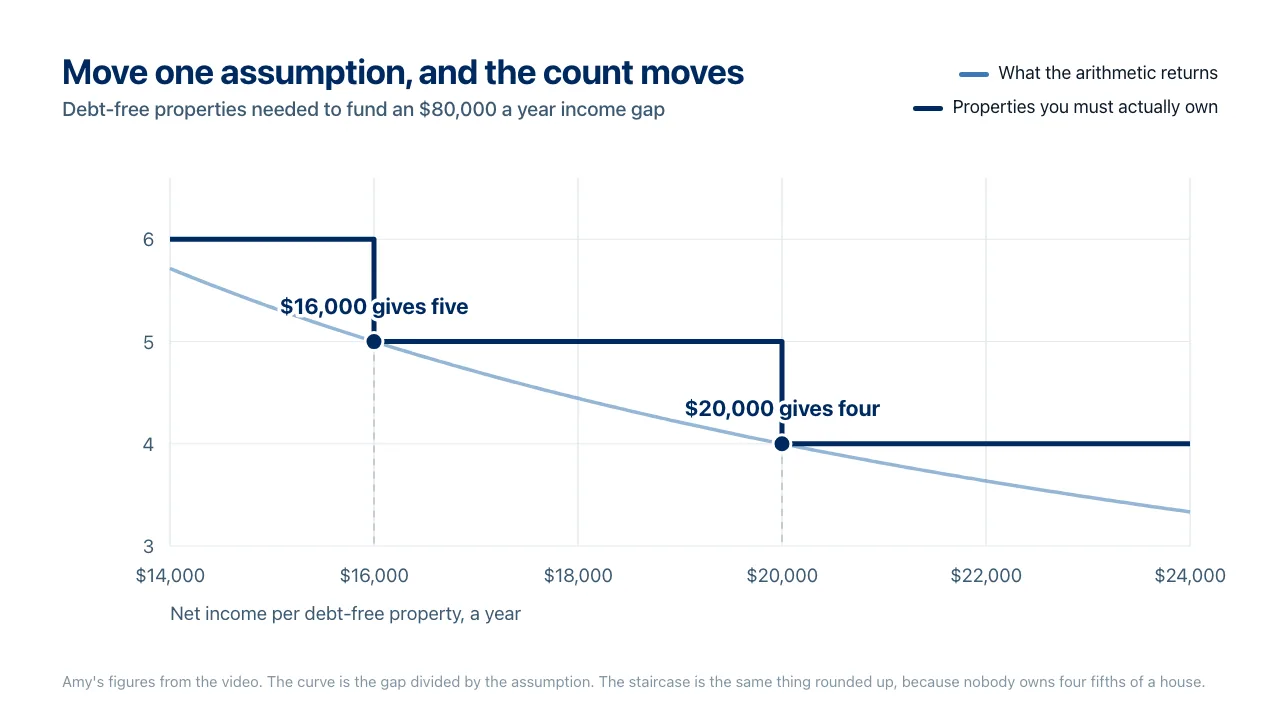
Take that $20,000 down to $16,000, as a more conservative long-term assumption rather than a reaction to one bad year. The weeks a property sits empty are one of the inputs most worth being honest about, and managing property risk covers the rest of them.
Same person. Same retirement. Same portfolio. The answer is now five.
A twenty per cent cut to the assumed net income raises the required portfolio by twenty five per cent. That is not a quirk of Amy's figures, it is the shape of the arithmetic. The required base is the gap divided by the net income, so it moves inversely with the one assumption that is hardest to pin down and easiest to flatter.
If you take one thing from this page, take that. Your number is more sensitive to your net income assumption than to anything else you are likely to argue about.
See this run across two complete portfolios, free, in Buy, Wait or Sell
Where the number everybody quotes actually comes from
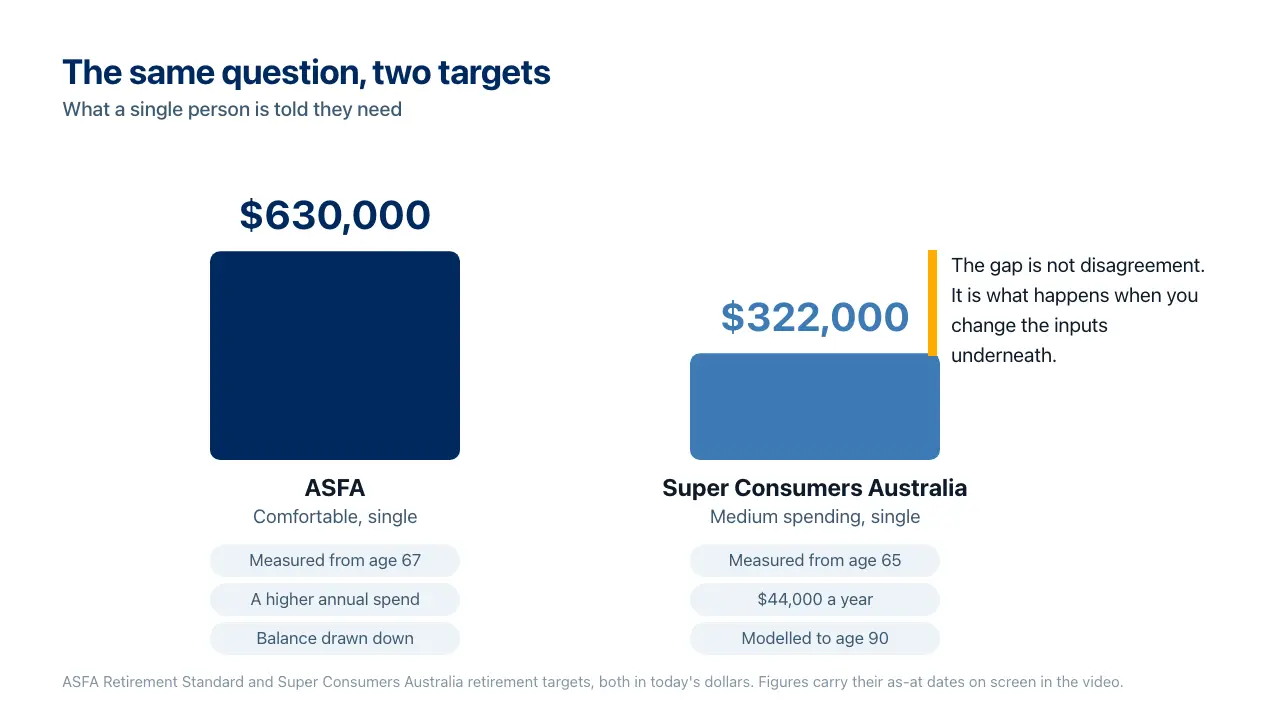
The benchmark you will see quoted again and again is the ASFA Retirement Standard. For a comfortable retirement at 67 it says a couple needs $730,000 and a single person $630,000, in today's dollars. (Source: ASFA Retirement Standard, read 1 October 2026.)
That is careful work. But it is a superannuation balance, not a property portfolio, and it rests on three assumptions printed in the notes under the table.
One. It assumes you own your home. This is not my figure, it is ASFA's: a single person on a modest retirement needs $110,000 if they own their home and $340,000 if they are renting. Same modest standard. Roughly three times the savings.
Two. It assumes you spend the capital. The model runs the balance down across your retirement. That is not necessarily what a property investor pictures.
Three. It assumes a part Age Pension. There is an assets test behind that, investment property counts towards it and the family home does not, and whether you would qualify is a question for your adviser.
One more thing worth knowing, because it trips people up: ASFA's budgets are updated quarterly, but the lump sum figures are not. ASFA says so directly, because the Age Pension built into them is indexed separately. And if you are wondering whether the super itself could hold the property, that is a different structure with its own rules, covered in the SMSF property guide.
A balance you drain is not a portfolio you keep
That benchmark answers one question: how much do I need so I can spend it down before I die.
The question many property investors are actually asking is different: how much do I need so I do not have to.
One is a tank you drain. The other is a tap you are trying to keep running, which is what people mean when they say passive income.
The two are not opposites. Plenty of people do some of both, and neither removes risk. A tap can dry up. Tenants leave, rates rise, roofs fail. The distinction is only this: one plan expects the capital to be gone, and may realise capital gains along the way, the other is trying to keep it and live off what it makes. Those need different numbers, and the difference often gets lost.
Super Consumers Australia publishes a benchmark too. For a single person at a medium spending level it is $322,000, against ASFA's $630,000. (Source: Super Consumers Australia retirement targets, read 1 October 2026.)
That gap is not two organisations disagreeing. Super Consumers models a single person from 65 out to 90, on $44,000 a year. ASFA models from 67, on a higher spend. Different inputs, different answer. Exactly what happened to Amy's count when I moved one number.
Two words in that standard are doing more work than you think
"Comfortable" is a defined term, not a feeling
Comfortable is specified in ASFA's own table. It includes top level private health cover, a reasonable car, regular leisure, an annual domestic trip and one overseas trip every seven years. On the current figures that is $56,166 a year for a single person and $78,998 for a couple. (Source: ASFA Retirement Standard budgets, June quarter 2026.)
That is a good life. It is also a specific one. If your retirement means more travel, helping the kids into something, or real money behind a cause you have believed in for thirty years, that is not what comfortable costs for you. Put your own number into step one, not somebody else's definition.
"67" is an assumption, not your retirement date
ASFA's lump sum is calculated at 67. Super Consumers' current-retiree target starts at 65. If you want to stop at 55, neither headline number is answering your question, because you have added another decade your own assets have to fund.
The arithmetic runs both ways, and that is the point
For one person these three steps say the portfolio is already big enough and the next job is the debt. For another, on exactly the same steps, they show a real income gap and the answer is more property. If that is you, the question becomes what to buy and in what order, which is what building a property portfolio in the right order is for.
Which one you are is not something anybody can tell you from a page.
If you are sitting there thinking your number just went up, that is not bad news. It is the first true thing the arithmetic has told you about yourself.
What I would not do, and I am a buyer's agent
Amy's answer came back at the equivalent of four properties owned outright. So if she were sitting on four with debt against them, I would not be pointing her at a fifth. I would be pointing her at the debt on the four.
The fifth one adds an asset and subtracts capacity. You may have the equity; capacity is what runs out first. If you want to see what your own plan does when rates move against it, our property stress test calculator models it at plus three per cent.
Remember what I do for a living. I run a buyer's agency. We take no commissions from developers or agents, and we are only paid when somebody engages us to buy. So "you do not need another property" is not the convenient answer in my business. It is what the numbers say often enough that I would rather say it out loud.
Once the answer changes from buying to debt reduction, the whole strategy changes: selling one, redirecting surplus, restructuring the loans, or paying them down faster. That is a different calculation, worth doing properly rather than guessing.
The honest part about stopping
The reason people keep buying past their number is not usually greed. It is that stopping can feel strangely like giving up.
Property gives you a very visible scoreboard. Number three, number four, number five. But nobody sends you a letter when you arrive. You notice one day that the thing you were building is finished, and the only person who will tell you is you.
Three questions to take to your own adviser
Whatever you decide, ask these in your own words, about your own position.
- On my position, what net income do I actually need, and what does that become if I want to stop before 67?
- What does one of my properties really leave me after everything including tax, and what would it leave me with the debt cleared?
- Given my assets, should a part Age Pension be part of my plan, or should I assume it is not?
Screenshot those, because the version of you reading a headline in six months is not this one. If it helps to see how other households got there, our client results set out the positions they started from.
Frequently asked questions
How many investment properties do you need to retire in Australia?
There is no single number. It is the income you need from property, divided by what one debt-free property actually nets you after all costs and tax. For the household worked through above that was $80,000 divided by $20,000, which is four properties owned outright. Change either figure and the count changes.
Is four investment properties enough to retire on?
Only if four debt-free properties produce the income you need. Four with debt against them is a different position entirely, because the loan payments come out before anything reaches you. Run the three steps on your own figures rather than borrowing somebody else's count.
How much rental income do you need to retire?
Start from what your life costs once the mortgage is gone, then subtract everything that is not property: super, shares, a partner still working, a part Age Pension. What is left is the income property has to produce. Use net income, not rent.
What is the difference between the ASFA number and a property portfolio?
The ASFA Retirement Standard is a superannuation balance that the model expects you to spend down, and it assumes you own your home and receive a part Age Pension. A property portfolio built for income is trying to do the opposite: keep the capital and live off what it produces. They answer different questions and the numbers are not interchangeable.
Should I buy another property or pay down the debt on the ones I have?
It depends on whether the arithmetic says you have an income gap. If the required count is four owned outright and you hold four with debt, the next job is usually the debt, because another purchase adds an asset and subtracts borrowing capacity. If there is a genuine gap, more property may be the answer. Have an adviser who knows your tax position confirm it.
Work out how many investment properties you need, on your own figures
I run through this across two complete client portfolios, with the numbers on screen, in Buy, Wait or Sell. It is free and it runs for 75 minutes, there is time for questions, and there is nothing to prepare.
Come and listen, or follow along with your own figures. Bring nothing but the question.
Save my seat for Buy, Wait or Sell

Rasti Vaibhav, CFA Charterholder, founder of Get RARE Properties.
More than nine years managing institutional portfolios at Westpac and AMP Capital, and more than 15 years investing in property personally. Author of The Property Wealth Blueprint. More about Rasti.
General information only. We're licensed buyer's agents, not financial or tax advisers, so please check anything that affects your money with your own adviser.