
Australian Financial Review, news.com.au, Daily Mail Australia, realestate.com.au, Canstar and Property Insights with Mark Bouris. Featured in more than 40 publications since 2022: explore our media appearances.
Home / Insights / Due Diligence / Questions to ask the selling agent
Questions to ask a real estate agent when buying: the four I use, and the one I never ask
The agent who walked you through the house on Saturday was not lying to you. They also are not working for you. Here are the four questions that tell you what is real, from a buyer's agent who sits across from selling agents every week.
What is the selling agent's job?
The selling agent is the real estate agent the vendor engages to sell the property. Their contract is with the vendor, and their job is the best price and terms for that client, inside the campaign's deadline. They can be friendly, helpful and honest with you, and still be working for the other side of the price.
🎥 Watch first: Buying Property? 5 Things the Selling Agent Is Doing Behind the Scenes (11 minutes): the three facts behind what the selling agent is doing, the five forces they produce, and the four questions I ask before making an offer.
Fast facts:
What the law now says about price information, by state (Consumer Affairs Victoria, NSW Fair Trading: 2026)
- Victoria: for auctions and fixed-date sales on and from 16 October 2026, the seller's reserve must be published at least 7 days beforehand, as a single dollar amount. If it is not, the sale cannot go ahead. (Source: Consumer Affairs Victoria, page updated 2 October 2026, read 15 October 2026.)
- Victoria: from 1 October 2026, a Property Price Statement replaced the Statement of Information, with key features of each comparable property, displayed prominently in online advertising. (Source: Consumer Affairs Victoria, read 15 October 2026.)
- NSW: since 29 June 2026, NSW Fair Trading can require an independent valuer to verify an agent's estimated selling price, and maximum penalties for offences such as dummy bidding reach $110,000 for a corporation. (Source: NSW Fair Trading, published 8 July 2026, read 15 October 2026.)
- NSW: a price guide in advertising, a Statement of Information and an underquoting maximum of $110,000 or three times the agent's commission have not started yet. They are expected towards the end of 2026, with no date announced. (Source: NSW Fair Trading, read 15 October 2026.)
Short answer: the best questions to ask a real estate agent when buying turn guessing into checking. The selling agent is not lying to you, and is not working for you either. Ask four things. What stage is the other buyer at: interested, verbal offer, written offer or signed contract? What comparable sales sit behind the price guide, and why are they comparable? Has the price expectation moved since launch? What happens if the vendor does not get their number on the day? And never ask what the vendor will accept.
I am Rasti Vaibhav, a CFA Charterholder and a licensed buyer's agent, and I sit across the table from selling agents every week. So hold that against me: this page describes what I get paid to do. The questions are yours to use either way.
The selling agent is not lying to you. They are just not working for you.
Here is the misread almost everybody makes. The agent is friendly. They remember your name. They text you the contract. They ask about your kids. Somewhere in the second week, you start treating them like your agent.
They are not. That is not a criticism. It is a job.
I hear it all the time. "He said he'd look after us." "She said the vendor really liked us." My question is always the same: who is paying them? The selling agent's contract is with the vendor, written into the agency agreement before you ever see the listing. On the other side of the table sits the buyer's agent, engaged and paid by the buyer, and most buyers do not have one in the room.
Once you hold that, almost everything in a property campaign makes more sense.
Three facts that explain what the selling agent is doing
One. The agent is paid by the vendor, not by you. Their contract is with the person selling.
Two. They are working the other side of the price. Their client wants the best price and terms they can get. Your job is the opposite: buy the right property without paying more than you need to. It is just which side of the number you are standing on.
Three. They are working to a clock. A campaign has a start, an auction date or a deadline, and a vendor who gets more anxious every week it runs. A campaign that drags costs the agency money and costs the vendor confidence.
Here is the part that surprises people: the vendor is being managed too. The agent is often standing between two people who want different numbers, moving the vendor down toward the market and moving you up toward the vendor. Same person, same fortnight.
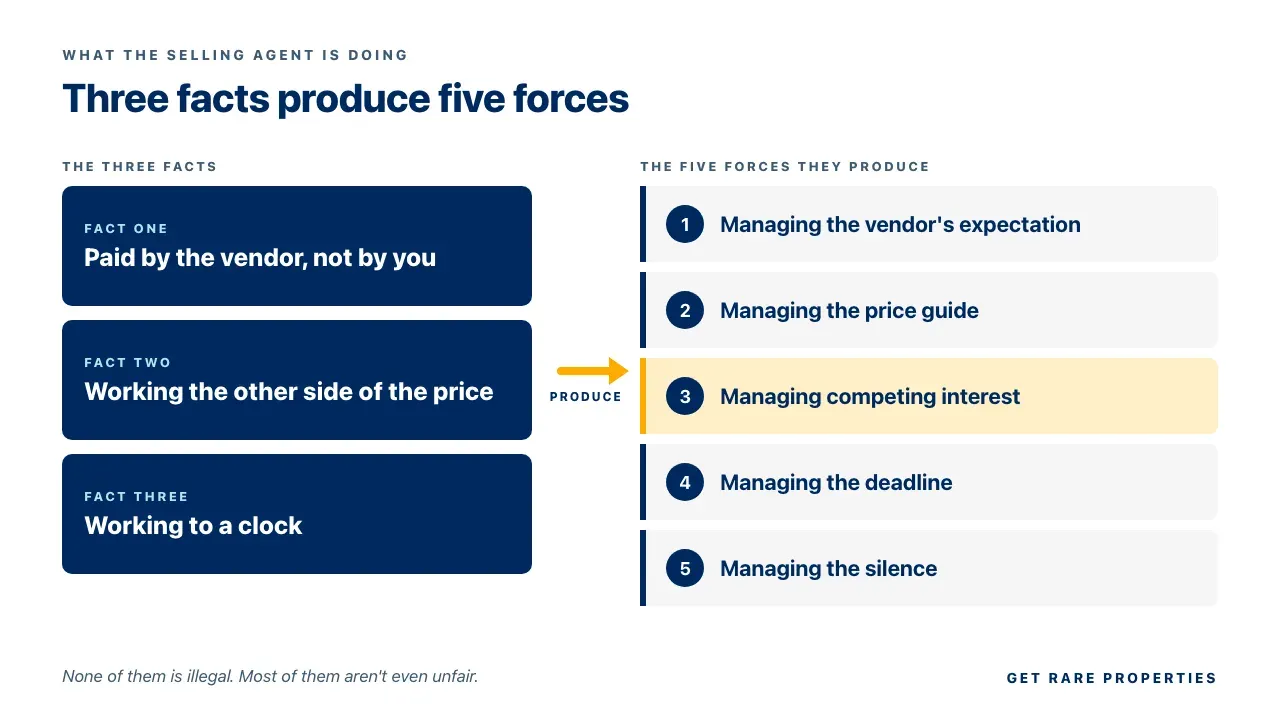
The five forces a buyer runs into
1. Managing the vendor's expectation
The vendor starts with a number in their head. Over the campaign, the agent feeds them evidence: open home numbers, buyer feedback, offers and comparable sales. That is one reason a price guide can move, but not the only one. Instead of guessing why the guide changed, ask what evidence changed.
2. Managing the price guide
A guide is the agent's estimate of the likely selling price. It is not the property's value, and it is not necessarily what the vendor will accept. So do not build your offer around the guide. Build it around the evidence behind it.
3. Managing competing interest
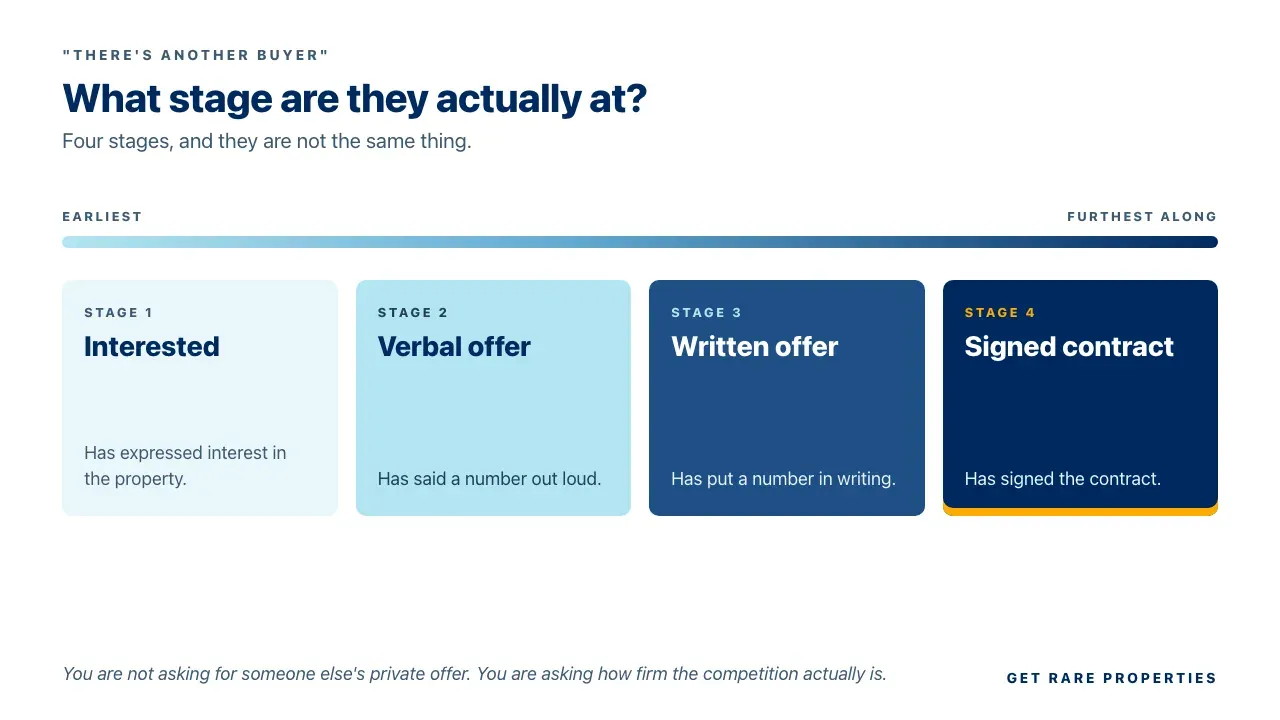
You make an offer and hear there is another buyer higher. That might be completely genuine. But "another buyer" can mean four very different things, and your job is not to decide whether the agent is lying. It is to find out how far that buyer has actually gone.
4. Managing the deadline
Offers close Friday at 5pm. The vendor is deciding this weekend. Those might be genuine. But if you have not finished your due diligence, sorted your finance and pre-approval with your broker, or decided your number, do not borrow the agent's clock. You may end up paying for their urgency. A deadline is exactly when the checks to finish before you make an offer get skipped.
5. Managing the silence
You put in an offer and nothing happens. A day, two days, and the silence starts working on you. It does not matter whether the gap is deliberate or just how the agent's week is going. I have seen buyers add $40,000 to an offer nobody had rejected, because two days of quiet felt like a no.
None of these five is illegal. Most of them are not even unfair. They are a job being done well for somebody else.
What has changed in the law, and what has not
Two of those forces, the guide and the other party, are getting harder to run, because the rules on price information are changing, state by state.
Victoria moved first. Its changes started on 1 October 2026 and apply to auctions and fixed-date sales on and from 16 October 2026: the seller's reserve published at least seven days beforehand as a single dollar amount, or no sale, and a Property Price Statement showing the comparable properties behind the estimate. (Source: Consumer Affairs Victoria, read 15 October 2026.)
New South Wales is part of the way there. Some changes started on 29 June 2026, including higher penalties for dummy bidding and a power to have an independent valuer verify an agent's estimated selling price. The ones a buyer will feel most have not: a price or price range in advertising, a Statement of Information listing the comparable sales, and an underquoting maximum of $110,000 or three times the agent's commission, whichever is higher. NSW Fair Trading expects them towards the end of 2026, with no date announced. (Source: NSW Fair Trading, published 8 July 2026, read 15 October 2026.)
None of that turns the selling agent into your agent. It simply gives you more information to test. Laws differ by state, so check your own state's regulator before relying on any of this.
The four questions to ask a real estate agent when buying
None of these is rude, and none of them is clever.
- When you hear there is another buyer: what stage are they actually at? Interested, verbal offer, written offer or signed contract? If you remember one question, make it this one. You are not asking the agent to disclose someone else's private offer. You are asking how firm the competition actually is.
- What are the comparable sales behind the price guide, and why are they actually comparable? Same pocket, similar land, similar accommodation, similar condition, recent enough to matter. Three addresses on a page do not automatically make three comparable sales. If the comparables do not hold up, neither does the evidence behind the guide.
- How long has this been on the market, and has the price expectation moved since it launched? You are asking what evidence changed, without asking the agent to hand over a private conversation with their vendor. A long time on the market can mean a vendor more motivated to sell, or a price that was wrong at launch. The second half of the question helps you tell which.
- If the vendor does not get the number they want on the day, what happens next? You are finding out whether auction day is genuinely the decision point, or just another stage in the campaign.
Write the four down and take them to the next inspection. You will be a different buyer by the second one.
Get the one-page plan before you make an offerFree, one page: five things that rule a property out, and five questions to answer before you buy.
The one question I never ask the selling agent
The question I never ask is: "What will the vendor accept?"
It feels like the smart question, and I have wanted to ask it myself. It is not. Sometimes the vendor knows exactly what they will take. Sometimes they do not. Sometimes the agent already knows where the conversation is heading. None of that changes the problem: you have just asked the other side of the negotiation to set your price for you.
I would rather work out what the property is worth to my buyer, make our offer from the evidence, and let the vendor respond.
Two things I never do once an offer is in
I never fill the silence. It works on me too. It just does not get to decide. If I have made an offer and nothing comes back, nothing is my answer too, and I will wait as long as it takes, because the clock is theirs, not mine.
I never let their deadline rush a decision I am not ready to make. If offers close Friday and I am not ready Friday, I am not in on Friday. Not ready usually means one specific thing is missing, a building and pest inspection not yet read or a contract not yet back from your solicitor, and a deadline does not make it less missing.
There is another house. There is always another house. There is not always another $60,000, and that is the part you will still be paying for in fifteen years, when you have forgotten the address of this one.
That is not toughness. It is knowing whose side of the table you are on, and staying on it.
The honest case for the selling agent
I want to be straight about this, because it is the strongest argument on the other side.
A selling agent can be excellent at their job, and most of their campaign work is ordinary and legitimate. Deadlines are often real. The other buyer is often genuine, and a verbal or written offer is still a real offer, just an earlier stage than a signed contract. An agent who will not tell you everything is not hiding something sinister. They have a client, and it is not you.
There is also a floor under all of it. The ACCC says it is illegal for real estate agents to mislead consumers about a property's price, and that agents must not mislead consumers to encourage higher offers. (Source: ACCC, Real estate, read 15 October 2026.)
So the four questions accuse nobody. They ask for evidence, not the vendor's private conversations, and the law is moving more of that evidence into the open anyway.
Can you ask the real estate agent these questions yourself?
The questions, yes. One advantage an experienced buyer's agent has over a first-time buyer is repetition: we have heard these conversations before. You can close a lot of that gap with four sentences on the back of your hand.
What is harder alone is interpreting the answers: which comparable sales actually hold up, when a guide is supported by the evidence, and whether a quiet Tuesday means anything at all. I get a lot of practice at that, and our client results show the kind of purchases that practice has gone into.
If you would rather have someone across the table from selling agents every week on your side, the next step is a call, not a contract. We look at where you are up to, what you are trying to buy, a home or an investment property, and whether having a buyer's agent actually makes sense for you, including what a buyer's agent costs against what it might save. Sometimes the honest answer is that you do not need one.
Book a Strategy Call 45 minutes, complimentary, with Rasti. Nothing to buy on the call.
Frequently asked questions
What questions should I ask a real estate agent when buying a house?
Ask four. What stage the other buyer is at: interested, verbal offer, written offer or signed contract. What comparable sales sit behind the price guide, and why they are comparable. How long the property has been on the market, and whether the price expectation has moved. And what happens next if the vendor does not get their number on the day.
Who does the real estate agent work for when you are buying?
The selling agent works for the vendor. Their contract is with the person selling, written into the agency agreement before you ever see the listing, and the vendor pays them. They can be helpful and honest with you, but their client is the seller.
Is the agent lying when they say there is another offer?
It might be completely genuine, and it is the wrong thing to try to decide. Another buyer can be interested, have made a verbal offer, have put an offer in writing or have signed a contract. Ask which stage they are at, because those four are very different levels of competition.
Should I ask the agent what the vendor will accept?
No. It asks the other side of the negotiation to set your price for you, whether or not the vendor knows their number yet. Work out what the property is worth to you from the comparable sales, make your offer from that evidence, and let the vendor respond.
Do I have to make an offer by the agent's deadline?
No. A deadline may be genuine, but if your due diligence, your finance or your number is not settled, you are not ready. Missing one property is recoverable. Overpaying because of somebody else's clock is the part you keep paying for.
What changed for property buyers in Victoria in October 2026?
For auctions and fixed-date sales on and from 16 October 2026, the seller's reserve must be published at least seven days beforehand as a single dollar amount, or the sale cannot go ahead. A Property Price Statement listing comparable properties replaced the Statement of Information on 1 October.
General information only. We're licensed buyer's agents, not financial or tax advisers, so please check anything that affects your money with your own adviser. The property laws described here were checked at source on 15 October 2026 and differ by state, so check your own state's regulator before relying on them. Nothing on this page is a comment on any particular agent or agency.

About the author
Rasti Vaibhav is the founder of Get RARE Properties, an independent buyer's agency for property investors. He is a CFA Charterholder and spent more than nine years managing institutional portfolios at Westpac and AMP Capital before founding the firm in 2020. He sits on the REINSW Buyers' Agent Chapter Committee and is the author of The Property Wealth Blueprint.
Get RARE Properties is Featured On
Get RARE Properties is Featured On
Related Articles
Related Articles