

Australian Financial Review, news.com.au, Daily Mail Australia, realestate.com.au, Canstar and Property Insights with Mark Bouris. Featured in more than 40 publications since 2022: explore our media appearances.
Short answer: when a bank says no to a second investment property, it is usually saying no to that property at that size, not to you. The lender's calculator tests every loan you hold at a rate at least three percentage points above its own, counts only part of the rent, and leaves you a fixed amount of room. A purchase that costs more than that room gets a no. A smaller one, sized to the room, can get a yes from the same lender on the same incomes.
Watch first: one family, an illustration and not a client, taken through the lender's calculator line by line, from a no on the second property to a third.
I'm Rasti Vaibhav, a CFA Charterholder and a licensed buyer's agent. I've bought 22 properties with my own money, and before that I spent nine years in institutional investment, where the first question about any position was how big a position the book could carry.
A lender asks that same question about your second investment property, and it asks it first. This page walks through how the question is asked, using the same illustration as the video, so you can take the right questions to your own mortgage broker before you buy another property.
Why a bank says no to a second investment property
The bank is not grading the property, and it is not grading you. It is testing whether your whole set of loans still works in a bad year.
Three inputs decide the answer:
- The stress test. APRA, the bank regulator, expects lenders to assess new loans at an interest rate at least three percentage points above the loan's own rate. With investor rates around 6.5%, every loan in the illustration was assessed as if it cost 9.5%, the home loan included. In APRA's words, the serviceability buffer helps ensure that recent new borrowers can continue to service their loans if expenses and rates rise.
- The rent, shaded. Lenders typically count 70 to 80% of the rent, not all of it. The illustration uses 75%.
- The debt you already hold. Every existing loan is assessed at the same tested rate.
Interest rates set the starting point, and the buffer sits on top of them. Put together, these three inputs give one number that matters more than the price: the cost in the lender's eyes. It is the yearly repayment after the stress test, less the rent the bank counts. It tells you how much of your borrowing capacity one property uses up.
Equity can fund a deposit. Capacity decides the loan. Usable equity in your home can cover the deposit and costs on the next property. It cannot make the new investment loan fit your income. That is why using equity to buy an investment property is only half the question, and why a family with plenty of equity can still hear no.
The deposit side has its own limit. Borrow above 80% of a property's value and most lenders add a one-off premium that protects the lender, not you, and lenders mortgage insurance is worth understanding before you decide how much equity to release.
One family, one investment property, and a no
This is an illustration, not a client. Every figure belongs to the illustration, and every price sits under the national median.
| Input | The illustration |
|---|---|
| Household income | $190,000 a year, two incomes, two children |
| Home | Owner-occupied, with a loan of about $200,000 |
| Property one | A house, loan $465,000, rent $490 a week |
| Investor rate | about 6.55%, assessed at 9.5% |
| Rent counted | 75% |
Illustration only: not a real client, lender or lending decision. Figures are hypothetical and computed at the rates read in October 2026.
On the lender's calculator, property one costs about $28,000 a year of capacity: about $47,000 of assessed repayment, less about $19,000 of rent counted.
After the home loan, property one and a living-cost benchmark for a family of four, the calculator leaves them about $40,000 a year of room. Room is a surplus on the calculator. It is not money in the bank, and it is not rental income either: it is what the lender's model says the household could still absorb.
Then they asked about a second: a house for $680,000. Borrowing the full price and costs, about $714,000, it would cost about $50,000 a year in the lender's eyes. They had $40,000 of room. The answer was no, by about $10,000.
A $190,000 household income is a little under two average full-time wages, going by the ABS figures for May 2026. If you have heard no on a payslip like that, the gap between the income on the page and the answer in the room is this calculation.
The bank did not say no to a second property. It said no to that one.
The Buffer-First Sequence: purpose, horizon, buffer, then the purchase
The Buffer-First Sequence is the order the family used next, and it puts the suburb last.
- Purpose. One sentence on what the portfolio is for. For the family: income for their retirement.
- Horizon. How long you will hold, which shapes what kind of property fits. For the family: at least fifteen years, never forced to sell, so they put the land ahead of this year's rent.
- Buffer. Months of holding costs, set aside in cash or an offset account before the purchase. For the family: twelve months of the next property's interest and running costs with no rent at all, about $35,000, saved over a year.
- The purchase. Sized to the room the lender's calculator leaves. Only then the suburb.
On our ladder of Grow, Protect and Secure, Protect usually comes after Grow. This family did Protect early: the buffer went in before the second property, not after it. The Buffer-First Sequence is that order written down, and the property sequencing guide sets out the wider method for deciding when the next purchase is due.
Buying a second property smaller on purpose
About a year after the no, the family's second purchase was a $420,000 house, smaller than the first, and smaller on purpose.
It was not the better asset. It was the right size. In the lender's eyes it cost about $27,000 a year, against $40,000 of room. The answer was yes, with about $13,000 to spare.
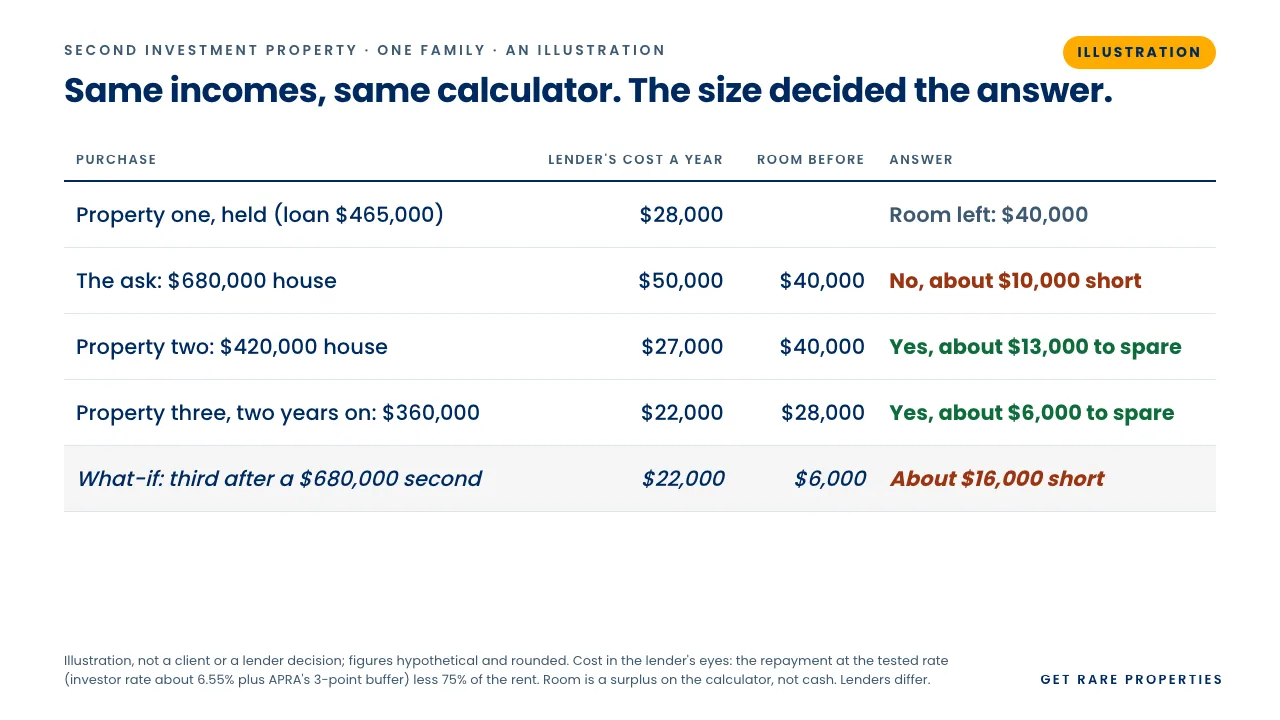
Same incomes, same calculator, a smaller property, and a yes. The size earned the yes.
The buffer did not change the bank's maths. In the illustration it is not counted as borrowing capacity. It changed what the family could survive after the purchase. A yes means you met that lender's test. It does not make the purchase safe.
Think of capacity as a block of land with a building envelope. The first build takes the footprint it needs, and everything after has to fit in what is left.
The third property, and the other order
Two years on, the room had grown back. Pay rises ran at 3.7% a year, the national average. Rents rose 5.5% a year, on Cotality's figures. In the illustration, rates stay put. With the home loan paid down too, the room reached about $28,000.
Property three was a house on a smaller block for $360,000. It cost about $22,000 in the lender's eyes, against $28,000 of room: yes, with about $6,000 to spare.
Now run the other order, as a what-if no lender approved. Buy the $680,000 house as the second anyway. The room after it is about $10,000 below zero. Two years on, it climbs back to about $6,000. The third property, costing about $22,000, is still about $16,000 short.
| Step | Cost in the lender's eyes, a year | Room before | Answer |
|---|---|---|---|
| Property one, loan $465,000 | about $28,000 | Held | |
| Ask: $680,000 house | about $50,000 | about $40,000 | No, by about $10,000 |
| Property two: $420,000 house | about $27,000 | about $40,000 | Yes, about $13,000 to spare |
| Property three, two years on: $360,000 | about $22,000 | about $28,000 | Yes, about $6,000 to spare |
| What-if, third after the $680,000 second | about $22,000 | about $6,000 | About $16,000 short |
Illustration only: not a client or a lender decision. Rounded figures; the exact sums vary by lender.
Two good properties, the second one too big, and the ladder stops at two. The case for the bigger asset is a fair point about the asset. It is not an answer about the portfolio.
In real life, rates move between purchases. The cash rate rose four times in 2026, and the RBA lifted it again to 4.85% from 4 November, after the video was recorded. The figures above are as recorded, and the sequence is unchanged. That is what the buffer is for.
Three ways to misread a no
The three misreadings are worth more than the numbers, because they are the ones I hear most.
A no on one property is not a no on you. Ask your broker what the calculator saw, and what a different size would do to it.
Small is not the goal. The smaller second was a holding decision inside a growth plan, sized to the room. Cash flow is what let the family hold. The land is why they bought. A property investor who buys small for its own sake has misread the lesson.
A yes is not a reason to skip the buffer. The buffer is yours, not the bank's. I wouldn't buy without one with my own money. It works like a rainwater tank: nobody admires it until it stops raining.
What I would do is write the purpose, set the buffer and size the purchase to the room, before I let myself like a suburb.
Seventy-two per cent of Australians with a rental property hold exactly one, on the Tax Office's count. Many of them heard a no that was about a size, not about them.
The Borrowing Capacity Playbook takes the lender's side of this one step further: the serviceability checklist, and the practical ways investors improve the room before the next purchase.
Get the Borrowing Capacity PlaybookThe Borrowing Capacity Playbook: free, the serviceability checklist and the practical ways to improve the room.
Your three numbers before a second investment property
None of these three numbers is assumed on this page. Each one is yours.
- Your purpose, with your horizon folded in, in one sentence. If you cannot write that sentence yet, that is the first job, before any suburb.
- Your buffer, in months of holding costs, decided before the purchase.
- Your room: what your lender's calculator leaves you, and what the next property would cost against it. That is a question for your broker to answer.
If you already hold more than one property and want the whole position read, that is what an ongoing portfolio review is for. How many properties you need in the end is a different question, covered in our guide to building a portfolio past the second property.
One honest limit
Nothing on this page tells you how much you can borrow. I don't know that, and I would be careful of anyone who claimed to without your numbers in front of them. Lenders weigh these things in their own ways, and the exact sums vary.
What it gives you is the order. Purpose, horizon, buffer, then a purchase sized to the room. The lender prices the bad year. So should the buyer.
Get the Borrowing Capacity PlaybookThe Borrowing Capacity Playbook: free, the serviceability checklist and the practical ways to improve the room.
Read the full video transcript
Transcript from the supplied subtitles.
Picture of family, an illustration, not a client. $190,000 a year between two incomes, two kids, one investment property, and a bank that just said no to the second. Three years later, they hold three investment properties. The one that got the yes cost less than their first on purpose. Every year is on the table. Read that no the wrong way and you stop at one. It wasn't a verdict on the family. It was an answer about one property. If you hold one property and your bank has told you there's nothing more, this is for you. If you have searched how to build a property portfolio and found only end states, here are the steps. 72% of Australian property investors hold exactly one. That's the tax officer's count. Here's the plan. What a property costs in the lender's eyes, the
number that said no, the buffer first sequence, purpose, horizon, buffer, then the purchase, and the decision the whole story turns on why the second was smaller on purpose. I'm Rusty Vavrov. I've bought 22 properties with my own money and I run an independent buyer's agency. There's a link below to talk to us. The sequence works whether or not you ever do. Stay for the second purchase. That 's where it turns. Note that this is general information only. I'm a licensed buyer's agent, not a financial or tax advisor, so check anything that affects your money with your own advisor. Every number here belongs to the family on screen, not to you. So the family, every figure on this card is the illustrations and by quartiles figures. Every price sits under the
national median. That's a firm that used to be CoreLogic. Two incomes, $190,000 between them, a home with still on it and one investment property, a house with a loan of 465,000. Then they asked the bank about a second, a house for 680,000. The answer was one word, no. Not not yet. Not how about a smaller one? No. 190,000 a good income, a little under two average full-time wages going by the Bureau of Statistics in May. If you have sat across a broker with a pay slip like that and heard no, you know the feeling. The page says yes, the person says no. Nobody explains the gap. It didn't say no to a second property. It's a no to that one. That difference is the whole video and the bank's calculator is where it lives. I'll open it right after the method. So here's what the
family did next and it's the method, the buffer first sequence. Four steps in this order, purpose, horizon, buffer, then the purchase. Purpose is one sentence on what the portfolio is for. Horizon is how long they'll hold, which helps shape what kind of property fits. Buffer is months of holding costs set aside in cash or in offset before the purchase. Then the purchase sized to the room the bank's calculator leaves and only then the suburb last. Our ladder has three phases, grow, building the portfolio, protect the cushion of equity in cash and secure paying it down. Protect usually comes after grow. This family did protect early. The buffer went in before the second property, not after it. The buffer first sequence is that order written down. So the calculator, it
runs on a stress test, the rent and the debt you already have. First, the stress test. APRA, the bank regulator, expects lenders to test new loans at an interest rate at at least three percentage points above the loans on rate. So, with investor rates around 6 and 1/2 %, this family's loans were assessed in this illustration as if every one of them, the home loan included, cost 9 and 1/2. You might be thinking, I pay 6 and 1/2, so why 9 and 1/2? Because bank isn't pricing today, it's pricing the year that goes wrong. Could they still pay if rates rose? APRA calls it the servicability buffer. In this video, buffer means the family's cash. APRA's own words, the 28th of May this year, the servicability buffer helps ensure that recent new borrowers can continue to service their loans
in the face of higher expenses and interest rates. On property one's loan of 465,000 over 30 years, principal interest 9 and 1/2 is an assessed repayment of about $47,000 a year. Then the rent. This is the one the smaller second turns on. Lenders typically count 70 to 80 % of the rent. That's broker practice and every lender differs. For this example, I've used 75. On property one's 490 a week, that's about 19,000 a year counted. Last, the existing debt. Every loan the family already has assessed the same way. Think of a lender as an engineer rating a balcony, not for the people standing on it today, for the crowd that could be. The lender does the same with your loan in its own way. Put them together and you get the cost in the lender's eyes. What
a property costs the family's capacity. It's the repayment after the stress test less the rent the bank counts. Equity can fund a deposit. Capacity decides the loan. The no came from capacity. So put property one's two numbers together. 47,000 of SS repayment less 19,000 of rent counted. In the lender's eyes, property one costs about 28,000 a year of capacity. After the SS costs of the home loan and property one and a living cost benchmark for a family of four, the calculator leaves them about $40,000 a year of room. Each line is on the card. Room is a surplus on the calculator. It isn't money in the bank. That's their number. Yours will be different. Property one was a growth purchase, the bigger asset bought first, chosen for the land under it. So far, property one costs
28,000 of their capacity and after it they have about 40,000 of room left. Now the one they asked about the property they wanted 680,000 with stamp duty and costs. They'd borrow all of it, about 714,000 a loan on the new house plus the deposit borrowed against their home. That adds risk and it's one to talk through with your advisor. This lender's calculator assesses the debt at 9 and 1/2 then counts only part of the rent. In the lender's eyes, it costs about 50,000 a year of capacity. They have 40,000 no by about 10,000. This is the moment the comment under my videos describes banks are not giving me anymore. Heard that no yourself? A like to this video helps the next person find this. So what was the no about? Now a what if? And watch what happens to
the third. No lender approved this model the 680 anyway. On the same calculator the room after it is about 10,000 below zero. Two years on with pay rises and rents up the room climbs back to about 6,000. The third property costing about 22,000 is still about 16,000 short. Two good properties the second one too big and the lender stops at two. Think of capacity as a block of land with a building envelope. The first build takes the footprint it needs and everything after has to fit in what's left. Will the second one too big and there's no land for the third. Next the same family and a yes. That was the what if? Back to the family's own path. But a year on they ran the buffer first sequence instead. Purpose income for the retirement horizon at least 15
years never forced to sell so they put the land ahead of this year's rent. Buffer 12 months of the next property's interest and running costs with no rent at all in the offset before they signed. About $35,000 saved over that year. Again they borrowed the full price and costs a loan on the new house plus the deposit borrowed against their home. The buffer is their own cash in the offset than the purchase. Here's the part that's easy to mess. The second was smaller on purpose. A house for 420,000 not because it was the better property but because of what it costs in the lender's eyes about 27,000 a year with a working on the card. Against 40,000 of room yes with about 13,000 to spare. Size to leave room for the third. The broker this time that one works. Same incomes,
same calculator, a smaller property and a yes. The size earned the yes. The buffer didn't change the bank's marks. In this illustration, it isn't counted as boring capacity. It changed what the family could survive after it. And that spare room is why the third purchase fits. Two years on, pay rises run at the national average 3.7% a year. Quarterly has rents rising 5 and 1/2% per In the illustration, rates stay put. With two years of pay rises, rent rises and the home loan paid down, the room grows to about 28,000. Property three, a house on a smaller block for 360,000. You'll find the working on the card. Its cost is about 22,000 against 28,000 of room. Yes, with about 6,000 to spare. In real life, rates move between purchases. The cash rate rose four times in 2026 as of 25th
of October to 4.6%. That's what the buffer is for. Not a formula, not a typical result, a family, an illustration, and the way lenders assesses, which is real. The exact sums vary by lender. Before you use this, the misreadings because I'd rather you heard them from me. One, remember the no at the start. The first misreading is hearing a no on one property as a no on you. Ask your broker what the calculator saw and what a different size does to it. Two, buying small for its own sake. The smaller second was a holding decision inside a growth plan sized to to room. For this family, cash flow is what led them hold and the land is why they bought. Three, skipping the buffer because the bank said yes. A yes means you met that lender's test. It doesn't make the purchase
safe. The buffer is yours. Think of it as the rain water tank. Nobody admires it until it stops raining. I wouldn't buy without one with my own money. What I would do is write the purpose, set the buffer, and size the purchase to the room before I let myself like a suburb. Nothing in this video tells you how much you can borrow. I don't know that, and I'd be careful of any video that claimed to. Now to yours. Three numbers and none of yours is assumed here. Screenshot this. One, your purpose with your horizon folded in in one sentence. If you can't write that sentence yet, that's the first job before any suburb. Two, your buffer in months of holding costs decided before the purchase. Three, your room, what your lender's calculator leaves you and what your next property
would cost against it. That's a question for your broker to answer. How many you need is a different video. Tap the card at the top of the screen. So where does this leave you? Purpose, horizon, buffer, then a purchase size to the room. What it can't tell you is your sizes, your purpose, or whether the property you're looking at it, the 420 or 680 of your own story. Tell me in the comments which of the three numbers you already have and which one is still missing. If the buffer first sequence is the question on your own numbers, that's what the strategy call is for. 45 minutes with us. We need where you are now. Write the purpose and horizon with you, set the buffer, and map out the order of your next steps. The link is below. General
information only, as I said at the start, and your numbers belong with your own advisor. The family was an illustration. Lenders weigh these things in their own ways, and the order still matters. The bank didn't say no to a second property. It said no to that one. Now you know the difference.
Frequently asked questions
Why did the bank say no to my second investment property?
Usually because that property, at that size, would cost more than the room the lender's calculator leaves you. Lenders test every loan at a rate at least three percentage points above its own rate, count only part of the rent, and add your existing debts at the same tested rate. A smaller property can fit the same room.
What is the serviceability buffer?
The serviceability buffer is the margin APRA expects lenders to add when they test a new loan: at least three percentage points above the loan's own rate. APRA confirmed it would stay at 3 percentage points on 28 May 2026. With investor rates around 6.5%, a loan is assessed as if it cost about 9.5%.
How much of the rent do lenders count on an investment property?
Lenders typically count 70 to 80% of the rent. That is broker practice rather than a rule, and every lender differs. The illustration on this page uses 75%.
Is it worth buying a second investment property?
That depends on your purpose, your horizon and your buffer, and it is a question for your own adviser with your numbers. What this page shows is narrower: before any property is worth buying, it has to fit the room your lender leaves, with a buffer you set yourself.
Can I use equity to buy a second investment property?
Equity can fund a deposit, but capacity decides the loan. A family with plenty of equity can still hear no if the new loan, tested at the higher rate, costs more than the room their income leaves.
Should my second investment property be cheaper than my first?
Not as a rule. In the illustration, the second was smaller on purpose because it was sized to the room the lender's calculator left, and that left room for a third. The right size for you depends on your purpose, your buffer and your own lender's assessment.
How big should my buffer be before buying a second property?
The illustration's family set aside twelve months of the next property's interest and running costs with no rent at all, about $35,000. That was their choice for their plan. Your buffer, in months of holding costs, is a decision to make with your own adviser before the purchase.
General information only. We're licensed buyer's agents, not financial or tax advisers, so please check anything that affects your money with your own adviser. Nothing here tells you how much you can borrow or recommends any particular property or loan. The family is an illustration, not a real client or lending decision.