
Australian Financial Review, news.com.au, Daily Mail Australia, realestate.com.au, Canstar and Property Insights with Mark Bouris. Featured in more than 40 publications since 2022: explore our media appearances.
Rentvesting in 2026: The Strategy Most Australian Investors Get Wrong
Rentvesting is not the mistake. Running it by accident is. Most people rent where they want to live, buy what they can afford somewhere else, and have no plan for how the first decision leads to the second. That is not rentvesting. That is renting and owning at the same time, which is a different thing with a different result.
Done deliberately, rentvesting is a sequence: a defined entry, a defined hold, and a defined exit. Done by default, it is a purchase with no plan around it. The property is rarely the problem. The missing sequence usually is.
Get RARE Properties is Featured On
Get RARE Properties is Featured On
Short answer: Rentvesting still works in 2026 when it is run as a three-phase sequence, Grow, Protect, Secure, rather than as a one-off purchase. The order of your property decisions matters more than the individual property you buy. Define the home or lifestyle you actually want first, then work backwards through the three phases. New to the concept? Start with rentvesting explained, then come back for the sequence.
Key takeaways
- Rentvesting means renting where you want to live and owning an investment property where you can afford to buy.
- The deliberate version runs as three phases: Grow (acquire), Protect (decide), Secure (arrive).
- A rentvesting property is usually a growth asset, so cash flow is not the test at purchase.
- Investment debt quietly reduces the home loan you can later qualify for. Plan for it early.
- The 6-year CGT rule only helps if the property was your main residence first.
Prefer to watch? See the full breakdown on YouTube and subscribe for new insights each week.
What is rentvesting, and why do so many people get it wrong in 2026?
Rentvesting, defined: renting the home you want to live in while owning an investment property somewhere more affordable. It lets you enter the property market and build equity without giving up the suburb, the schools, or the proximity to work that matter to you right now.
A growing number of first home buyers in Australia are now choosing an investment property as their first purchase rather than a home. The strategy is popular. In most cases, the execution is not strategic at all.
It helps to separate the two versions that get blended together everywhere else. There is the default version, where you rent here, buy what you can somewhere else, and hope it adds up. And there is the deliberate version, run as a sequence with a defined entry, a defined hold, and a defined exit. The strategy is sound. The default execution is what fails.
I bought my first investment property in 2011 with about $80,000, most of it borrowed. Across the 21 properties I have acquired since, and the several hundred families we have worked with, who have built more than $750 million in equity between them, the pattern does not change. The rentvesters who end up where they actually want to be are not the ones who picked better suburbs. They are the ones who ran rentvesting as a sequence.
The right question is about order, not yes or no
Most rentvesting advice debates a single question. Should I rentvest, or shouldn't I? That is the wrong question. The better one is this: in what order do I make my property decisions across the next ten to fifteen years?
My years managing institutional portfolios taught me this directly. When you run a book worth billions, no single position matters as much as the order in which positions enter and exit the portfolio. Property works the same way. Most rentvesters start by asking what they can afford to buy. The deliberate ones start with the life they want, then work backwards. Same market, same income, same deposit, two very different ten-year outcomes.
The three-phase rentvesting sequence: Grow, Protect, Secure
This sequence sits inside our GPS Framework: Grow, Protect, Secure. For rentvesting, three phases are what matter. Phase 1 acquires. Phase 2 decides. Phase 3 arrives.
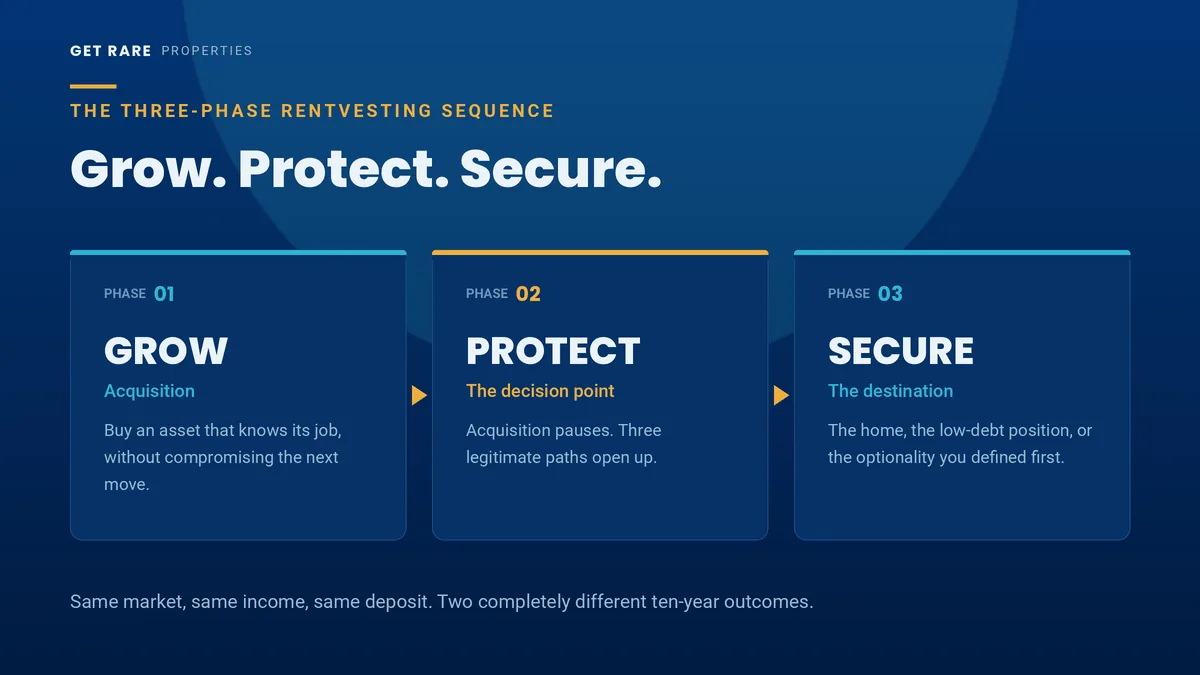
Each phase asks a different question, and the answer to one shapes what the next can be. Miss a phase, and the sequence quietly breaks, usually without you noticing until Phase 3, when it is too late to fix cheaply.
Phase 1 (Grow): buy an investment property that knows its job
In the Grow stage, the job is straightforward. Buy an asset that does the right work for the portfolio, without compromising your next move. Every property has a job: it is a Growth Engine, a Yield Stabiliser, or a Value-Add. A rentvesting property, almost without exception, is a Growth Engine. You are buying it for capital growth, not cash flow. So the rent versus mortgage comparison is not the test.
This is where accidental rentvesters lose the plot. A broker shows them a unit interstate. The cash flow looks neat. It is positively geared, so they buy. But a positively geared unit in a low growth market is not doing the Phase 1 job. It is doing a different job badly. Growth Engines are meant to grow. If you wanted yield, you would not have rentvested. You would have bought a home.
The 24-Month Win Test
Before any rentvesting purchase, we run three questions. The asset has to clear all three.
The first question is the job. What is this asset here to do? If you cannot name it in one sentence, you are not ready to buy. The second is the finance impact. Not just today's serviceability, but the borrowing capacity you have left for whatever comes next. We will come back to that in Phase 2. The third is the one most rentvesters never ask. What is the future fit? In 24 months, what has to be true for this to be a win? If you cannot define that in advance, you cannot hold the property calmly when the market wobbles.
There is one more rule for Phase 1, and I call it Buffers Before Bravado. A Phase 1 position has to survive a vacancy, a rate move, and a life event at the same time. Not any one of them on its own. All three together. That is not caution for its own sake. It is what lets you hold through a rough patch instead of selling at the worst possible moment.

Phase 2 (Protect): the decision point and three real paths
In Phase 2 the job changes completely. Acquisition pauses. Holding starts. This is the phase most rentvesters never enter, because nobody told them they were supposed to think about it.
The default in most rentvesting content is to keep buying. One, two, three, build the empire. But somewhere between your first purchase and the life you actually want, there is a decision point.
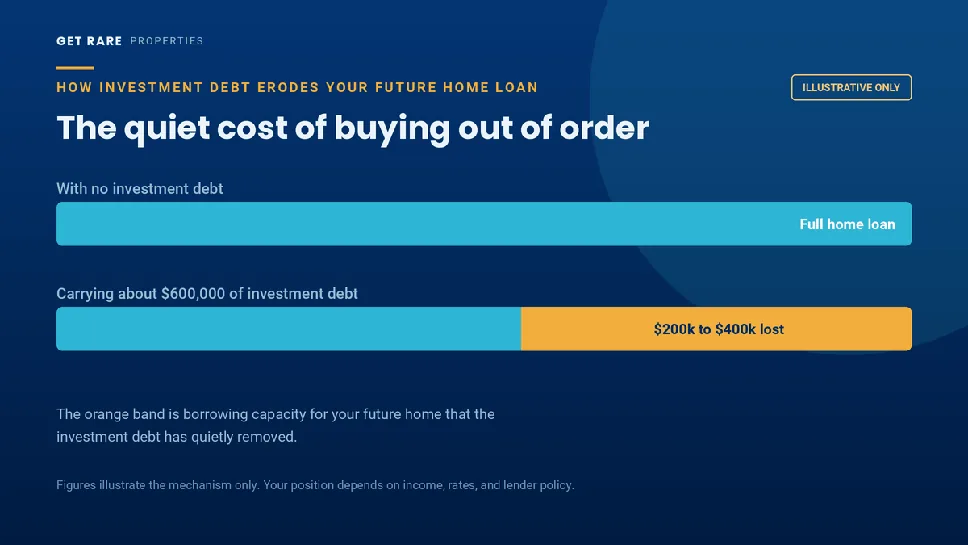
How investment debt affects your future borrowing capacity
To understand the decision, you need the arithmetic underneath it. Existing investment debt reduces the home you can later qualify for. Lenders are required to stress-test every loan at the actual rate plus a serviceability buffer, so investment debt is assessed well above current market rates. On top of that, rental income is generally counted at around 70 to 80 per cent, while the repayment liability is counted in full at the stressed rate. So as you accumulate investment debt, your future borrowing capacity for a home shrinks faster than the debt itself grows.
To put rough numbers on the mechanism, carrying around $600,000 of investment debt can reduce the home loan you qualify for by somewhere between $200,000 and $400,000. Those figures are illustrative and depend entirely on your income, rates, and lender policy. They are not a promise about your situation. But once you can see the mechanism, you can decide what to do about it.
Three legitimate paths at the decision point
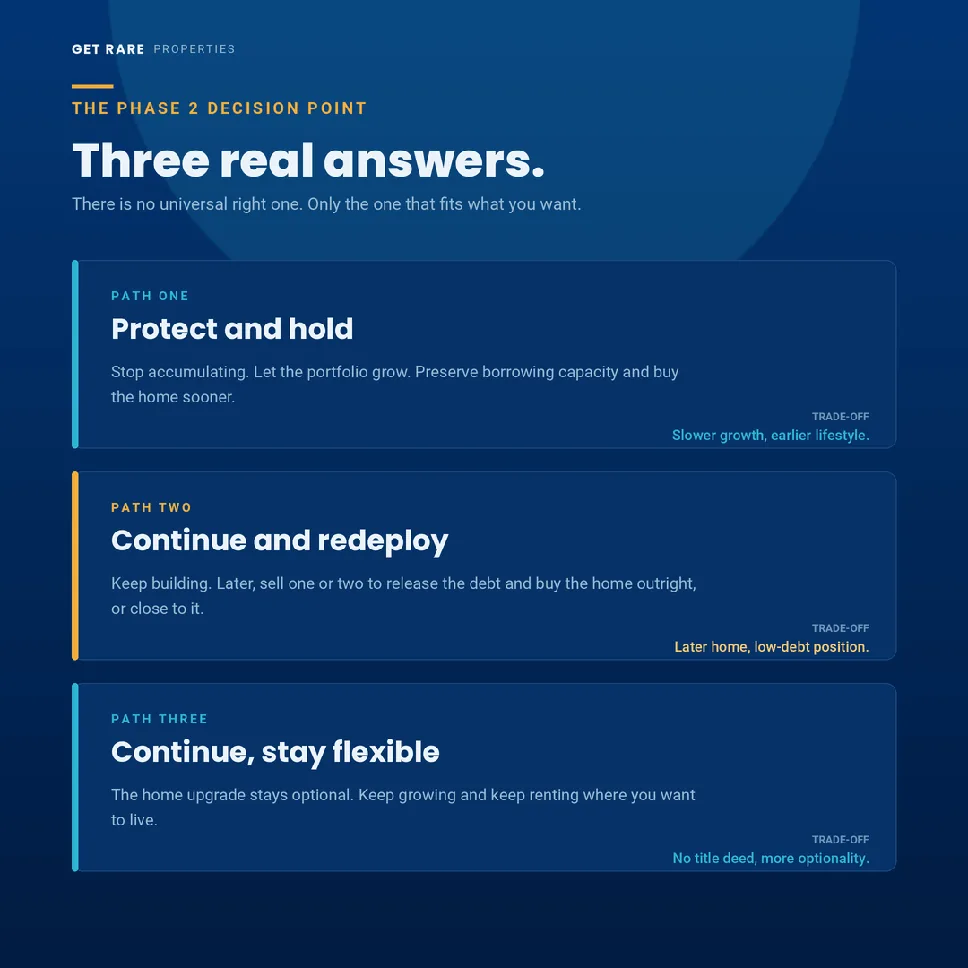
Most rentvesting content frames this as a single decision. It is not. There are three legitimate paths, and which one fits depends on what you actually want.
Path one is protect and hold. You stop accumulating, let the existing portfolio grow, preserve your borrowing capacity, and buy the family home sooner than you otherwise would. The trade-off is slower asset growth in exchange for an earlier lifestyle outcome.
Path two is continue and redeploy. You keep building through Phase 2, then sell one or two properties when the time comes to release the debt, and use the equity to buy the home outright or close to it. The trade-off is a later home in exchange for a low debt position at the upgrade point. If a low-debt or debt-free home is your real goal, the thinking in our Pay Off Mortgage in 10 Years masterclass maps neatly onto this path.
Path three is continue and stay flexible. The home upgrade itself stays optional. You keep growing the portfolio and keep renting in the lifestyle suburb you actually want to live in. The goal is not ownership of a specific house. It is wealth that gives you options. For households drawn to this path, the Fast Track Your Financial Freedom masterclass walks through how a portfolio turns into passive income and optionality over time.
There is no universal right answer here. Phase 2 is a decision, not a rule.
Phase 3 (Secure): the destination, and the 6-year CGT rule most people learn too late
Phase 3 is where the work of the first two phases either pays off or does not. In the GPS Framework this is the Secure stage. For rentvesters, the trigger is whichever destination you defined back in Phase 1: the home, the debt-free position, or the optionality. What decides the outcome is whether you knew, two phases ago, what you were aiming at.
One technical piece sits inside Phase 3 that almost every accidental rentvester learns about too late. It is often called the 6-year CGT rule. The rule can let you treat a former main residence as your main residence for capital gains tax purposes for up to six years after you move out, even while it is rented. It is one of the more generous provisions in the Australian tax system. But it has one firm condition. The property must have been your main residence first.
If you bought it as an investor first, that treatment is not available for that property. There is no fixing it later. The unit someone bought because a broker called it a no-brainer is locked into investor tax treatment. Sell it later to fund the home upgrade, and you may pay capital gains tax you could have legally reduced. Knowing this in Phase 1 changes the decision. Knowing it in Phase 3 only changes the regret.
This is general information, not tax advice. The main residence exemption and the six-year rule have conditions, and how they apply depends on your circumstances and how the property is held. Confirm the detail with a registered tax agent or accountant before you act.
Three households, same market, different sequence
The following are illustrative composites built from patterns we see often. They are not real clients. The point is the sequence, not the figures.
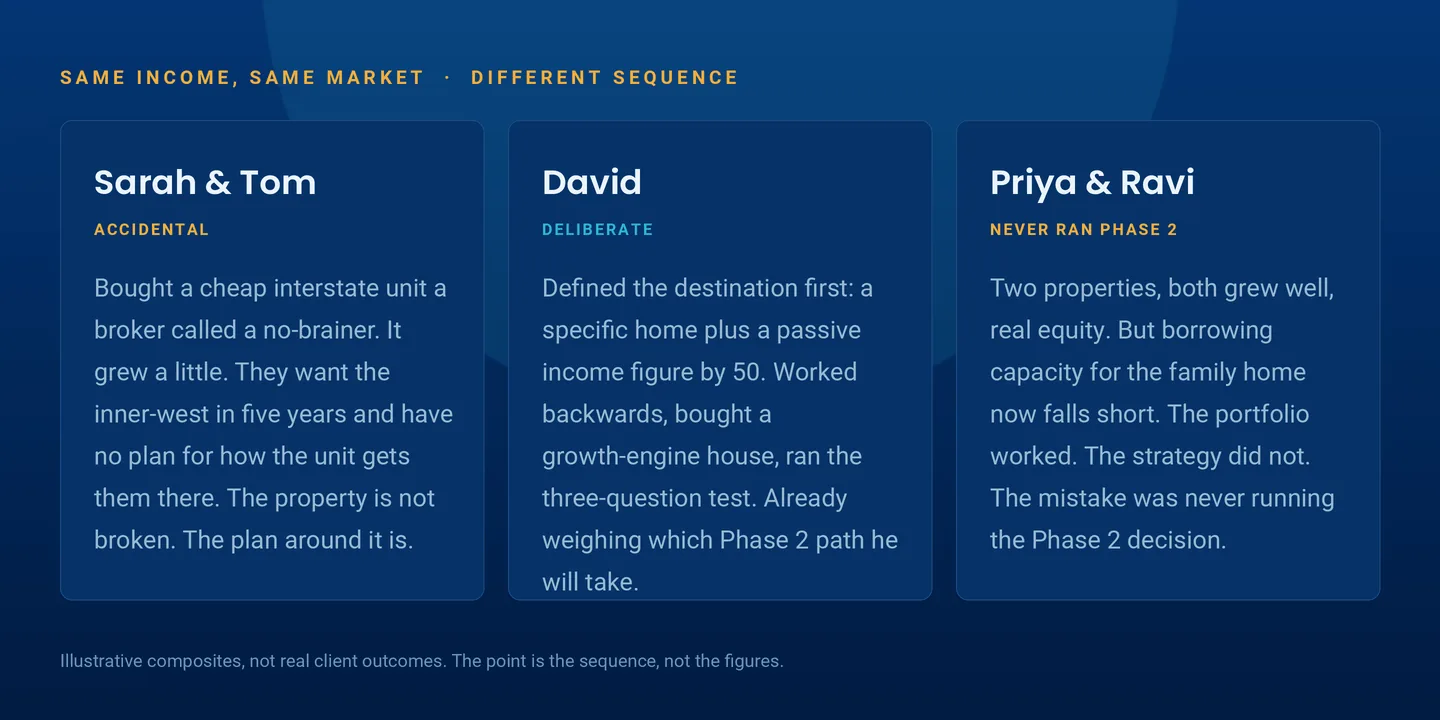
Sarah and Tom bought a cheap interstate unit a broker called a no-brainer. It grew a little. They want the inner-west within five years and have no plan for how the unit gets them there. The property is not broken. The plan around it is. That is accidental rentvesting.
David did it differently. He defined the destination first, a specific family home plus a passive income figure by a set age, then worked backwards and bought a growth-focused house. He ran the three-question test before signing, and he is already weighing which Phase 2 path he will take. The discipline is replicable. The only thing he did differently was decide what the destination was before he picked the first move.
Priya and Ravi bought two investment properties that both grew well and built real equity. But when they went to buy the family home, their borrowing capacity fell short. The portfolio worked. The strategy did not. The mistake was never running the Phase 2 decision, with the three paths on the table, while there was still time to choose.
How to apply the rentvesting sequence to your own situation
If you are rentvesting now, or weighing it up, here is the honest answer. You cannot tell whether it is working from the property alone. You can only tell from the sequence around it.
The practical step is not to buy, and not to sell. The practical step is to define what the destination actually is for you: the home, the debt-free position, or the optionality. Then walk the three phases backwards from there. What does Phase 3 need to look like? What does Phase 2 protect, or which of the three paths fits? Does the property you currently own fit the Phase 1 job in that sequence, or does it belong to a different sequence entirely? If those answers are clear, the next decision gets easier. If they are not, no amount of suburb selection will save the plan.
Frequently asked questions about rentvesting in 2026
Run rentvesting as a sequence and it does what it was always meant to do: buy you the freedom to live where you want now, and to choose the home, the low-debt position, or the optionality you want later.
What is rentvesting and how does it work in 2026?
Rentvesting means renting the home you want to live in while owning an investment property somewhere more affordable. It lets you enter the property market and build equity without compromising on where you live. In 2026 it works best when run as a planned three-phase sequence rather than a single purchase.
Is rentvesting better than buying your first home in 2026?
Neither is universally better. Rentvesting suits people who want to live in an area they cannot yet afford to buy in and are comfortable holding an investment property. Buying your own home suits people who value ownership and residential stability more than location or growth. The right choice depends on your goals and numbers.
Will rentvesting affect my future borrowing capacity?
Yes. Investment debt reduces the home loan you can later qualify for, because lenders stress-test loans above current rates and count rental income at only around 70 to 80 per cent. As investment debt grows, your future home-buying capacity can shrink faster than the debt itself. Planning for this in Phase 2 is essential.
What is the 6-year CGT rule in rentvesting?
The six-year rule can let you treat a former main residence as your main residence for capital gains tax for up to six years after moving out, even while it is rented. The catch is that the property must have been your main residence first. If you buy it as an investment first, that treatment is not available. Confirm details with your accountant.
How risky is rentvesting?
The main risk is not the property itself but the missing plan around it. Buying without a defined destination, a growth-focused asset, or a Phase 2 decision is where most rentvesters get stuck. Holding a buffer for vacancy, rate rises, and life events at the same time is what keeps the strategy safe through rough patches.
Where should rentvestors buy in 2026?
There is no single hot suburb answer. A rentvesting property is usually a growth-focused asset, so the market should be chosen for its ability to do that job, not for a cash-flow tip. The right location depends on your budget, timeline, and the destination you have defined, which is a decision worth mapping deliberately.
What are the tax benefits and implications of rentvesting in 2026?
Rentvesting can offer deductions on investment loan interest and property expenses, plus possible depreciation, while your rent stays a personal expense. The most significant long-term implication is capital gains tax and the six-year main residence rule. These depend on your circumstances, so get tailored advice from a registered tax agent.
Is 2026 a good year to start rentvesting?
Timing matters less than sequence. The households who do well are rarely the ones who timed the market. They are the ones who defined their destination, bought an asset with a clear job, and made a deliberate Phase 2 decision. A good year to start is one where you have a plan you can hold through a downturn.
Video transcript: The Wrong Order: 3-Phase Rentvesting
Video published 17 June 2026. Figures and statements reflect what was said at the time of recording. The article above provides the updated context. Captions have been corrected for names, terminology and spelling.
Read the full transcript (2,123 words)
Rentvesting is the right strategy. And most people doing it are doing it by accident. They're renting where they want to live, buying where they can afford somewhere else. And they have no plan for how one leads to the other. That isn't rentvesting.
That's renting and owning. And they aren't the same thing. Last year, more than 8,000 first home buyers in Australia bought an investment property instead of a home. That number has been growing faster than the entire owner-occupier first home buyer market. The strategy is exploding, but its execution in most cases is not strategic at all.
So, let's separate the two versions of rentvesting that get blended together everywhere else. The default version, where you rent here, buy what you can, and hope it adds up. And the deliberate version, run as a three-phase sequence with a defined entry, a defined hold, and a defined exit. The strategy is sound, the default execution is what fails. Across 21 properties of my own and several hundred families we have worked with, the pattern doesn't change.
The rentvesters who end up where they actually want to be are not the ones who pick better suburbs. They are the ones who run rentvesting as a sequence. This sequence sits inside our GPS framework, grow, protect, secure. There's a separate explainer for that linked below. For now, the three phases are what matter.
Most rentvesting advice debates a yes or no question. Should I rentvest or shouldn't I? That's the wrong question. The right question isn't what should I buy, it is in what order do I make property decisions across the next 10 to 15 years. Rentvesting isn't a destination, it's a first move in a sequence.
And the reason most rentvesters end up stuck isn't that they bought the wrong property. It's that they answered the wrong question on day one. The institutional world taught me this directly. When you manage a portfolio, no individual position matters as much as the sequence in which positions enter and exit. Property is not any different.
The order of decisions matters more than the decisions themselves. Most rentvesters start by asking what they can afford to buy. The deliberate ones start with the life they want. The home, the lifestyle, the timeline they want to keep open. They name the destination first, then they work backwards through the three phases.
Same market, same income, same deposit, but two completely different outcomes. Phase one is acquisition. In the GPS framework, this is the grow stage. The job is straightforward. Buy an asset that does the right work for the portfolio without compromising the next move.
Every property has a job. Growth engine, yield stabiliser, or value add. A rentvesting property, almost without exception, is a growth engine. You are buying it for capital appreciation, not cash flow. If it's a growth engine, the rent versus mortgage comparison isn't the test.
This is where most accidental rentvesters lose the plot. A broker shows them a unit interstate, cash flows look neat, positively geared maybe, they buy. But a positively geared unit in a low-growth market isn't doing the phase one job. It's doing a different job badly. Growth engines should grow.
If you wanted yield, you wouldn't have rentvested. You would have bought a home. Before any rentvesting purchase, we run the 24-month win test. Three questions. The asset has to pass all three.
One. What is the job of this asset? If you can't name it in a sentence, you're not ready to buy. Two. What is the finance impact?
Not just today's serviceability. The future borrowing capacity for whatever comes next. We'll come back to that in phase two. And the third one is the one most investors never ask. What does winning look like?
In 24 months, what has to be true for this to be a win? If you can't define that in advance, you can't hold the property calmly when the market wobbles. Any answer that isn't clear, the buy doesn't proceed. That's not caution. That's clarity.
And one more for phase one. Buffers before bravado. A phase one position has to survive vacancy plus a rate move plus a life event at the same time. Not any one of them, all three at the same time. Phase two is protect.
The job changes completely. Acquisition pauses. Holding starts. And the question on the table changes, too. This is a phase most investors never enter because nobody told them they were supposed to think about it.
They default to buy one, then two, then three, and build an empire. But somewhere between phase one and the life you actually want, there is a decision point. We call it the decision point because there isn't one right answer at that moment. There are three. To understand the decision, you need the arithmetic underneath.
Existing investment debt reduces the home you can later qualify for. Lenders are required to stress test every loan at the actual rate plus a serviceability buffer. Investment debt is being assessed at well above current market rates as a result. Rental income gets counted at 70 to 80%. Repayment liability gets counted at 100% at the stress rate.
So, as you accumulate investment debt, your future borrowing capacity for a home shrinks faster than your investment debt grows. Carrying $600,000 of investment debt can cut the home you can borrow for by $200,000 to $400,000, for example. That is a number, and once you can see it, you can decide what to do with it. Now, most rentvesting content frames this as a single decision. It isn't.
There are three legitimate paths, and which one fits depends on what you actually want. Path one, protect and hold. You stop accumulating investment property. You let the existing portfolio grow. You preserve future borrowing capacity.
You buy the family home sooner than you otherwise would have. The trade-off is slower asset growth in exchange for an earlier lifestyle outcome. Path two, continue and redeploy. You keep building the portfolio through phase two. When the time comes, you sell one or two properties to release the debt, and you use the equity to buy the home outright or close to it.
The trade-off is delayed gratification on the home in exchange for a debt-free or low-debt outcome at the upgrade point. Path three, continue and stay flexible. The home upgrade itself stays optional. You keep growing the portfolio. You keep renting in the lifestyle suburb you actually want to live in.
The goal isn't ownership of a specific house. It's wealth that gives you optionality. For some households, that's the better answer. There is no universal right answer there. Only the one that fits what you actually want.
Phase two is a decision you would have made. Phase three is where the strategy ends, and it's the part of the conversation almost nobody runs. In the GPS framework, this is the secure stage. Or for rentvesters, a partial secure when the trigger is whichever destination you defined back in phase one. The home, the debt-free position, or the optionality.
Phase three is where the work of the first two phases either pays off or doesn't. And what decides that is whether you knew two phases ago what you were aiming at. One technical piece sits inside phase three that almost every accidental rentvester learns about too late. The six-year CGT rule. The rule lets you treat a former main residence as your main residence for capital gains tax purposes for up to six years after you move out.
Even while it's rented. It is one of the most generous tax provisions in the Australian system. But it has one condition. The property has to have been your main residence first. If you bought it as an investor first, you lose access to that rule for the property forever.
There's no fixing it later. You bought through the wrong door. This is the phase that punishes accidental investors most. The unit they bought because the broker called it a no-brainer. It's locked into the investor stream for life.
Sell it later to fund the home upgrade and you pay the capital gains tax you could have legally avoided. The cost of buying in the wrong order can be six figures. Knowing it in phase three only changes the regret. Three households, none of these are real clients. They are composites built from patterns we see all the time.
Sarah and Tom, both 33, software engineer and marketing manager. Combined income, $260,000. Renting a two-bedroom in Sydney's inner east for $850 a week. A few years ago, a broker told them buying a $480,000 unit in Logan was a no-brainer for starters. They bought it.
Two years on, the unit is up to around $545,000. They are $20 a week out of pocket after rent and tax. Their own rent has gone up. They want the inner west within five years. They have no plan for how the Logan unit gets them there.
This is accidental investing. The property isn't broken. The plan around it is. They didn't run the sequence backwards from the home they wanted. So, the property they own doesn't know what it's for.
David, single, 31, mechanical engineer. $185,000 income, renting a one-bedroom in Carlton for $620 a week. Before he bought anything, he defined his freedom number as a life, not a number on a spreadsheet. A $1.4 million family home in Melbourne's inner north plus $80,000 of passive income by age 50. He worked backwards, bought a Brisbane corridor growth engine house at $720,000. Ran the 24-month win test before signing. 3 years on, the property has grown to $890,000.
He has clear visibility on phase two and is already weighing which of the three paths he'll take when he gets there. David isn't exceptional. The discipline is duplicable. The only thing he did differently was decide what the destination was before he picked the first move. And then, Priya and Roy, both 36, two kids under five, pharmacist and IT project manager.
Combined income $295,000. Bought their first IP at $550,000. Bought a second a couple of years later at $620,000. Both grew well. They have $480,000 of equity sitting across the portfolio.
They want to buy a $1.7 million family home in Sydney's inner west. Their broker tells them their PPR borrowing capacity tops out at $1.1 million. The portfolio worked. The strategy didn't. And here's where phase two mattered for them.
If they had reached the decision point 3 years ago, really reached it with the three paths on the table, they had three options. Path one, stop after the first IP, buy the home now at $1.5 million. Path two, sell one of the IPs before the home purchase, use the equity to bridge the gap. And path three, keep growing the portfolio, stay renting in the inner west long term. Let the wealth do the lifestyle work, not the title deed.
Each one is a real answer. Each one is a different life. And the mistake here wasn't accumulating, it was failing to run a decision. The thing that goes wrong in rentvesting is rarely the property. It's the missing transition logic.
If you are rentvesting now or weighing it up, here's the honest answer. You can't tell from the property. You can only tell from the sequence around it. The practical step isn't to buy, it isn't to sell. The practical step is to define what the destination actually is for you.
The home, the debt-free position, or the optionality. And walk the three phases backwards from there. What does phase three need to look like? What does phase two protect, or which of the three paths fits? Does the property you currently own fit the phase one job in that sequence, or does it fit a different sequence entirely?
If those answers are clear, the next decision gets easier. If they're not, no amount of property selection will save the plan. If you'd like help mapping your own GPS stage, your destination, and which of the three paths actually fits, the strategy session link is in the description. It's not a pitch, it's a diagnostic. Sometimes the answer that comes out of it is not to buy.
That's part of why we run it. And if you want the framework that sits underneath all of this, the GPS explainer is on the end card. That's the prerequisite one. Rentvesting isn't broken, it's just rarely run as a sequence. Treat it as one, and it works the way it was always meant to.
I'll see you in the next one.
General information only. We're licensed buyer's agents, not financial or tax advisers, so please check anything that affects your money with your own adviser.

About the author
Rasti Vaibhav is the founder of Get RARE Properties, an independent buyer's agency for property investors. He is a CFA Charterholder and spent more than nine years managing institutional portfolios at Westpac and AMP Capital before founding the firm in 2020. He sits on the REINSW Buyers' Agent Chapter Committee and is the author of The Property Wealth Blueprint.
Map your own rentvesting sequence
If you are already rentvesting, or about to start, and you are not sure which GPS stage you are in or which of the three Phase 2 paths fits your numbers, that is exactly what the strategy call is for. It is a structured 60-minute conversation to map your destination, your current position, and your next move. It is not a sales call. Sometimes the answer that comes out of it is to wait, and because we take no payments from developers or sales agents, that is an answer we are free to give.


